Pressing
Pressing yield
The proportion of a fruit charge recovered as juice, and why a single headline figure for it is not a meaningful number.
Also called Juice yield, Extraction rate, Press recovery.
- Stage
- Pressing
- Traditional in
- No single tradition — used wherever it suits
- What it most changes
- Phenolic character up, astringency up
- Safety
- None recorded
What it is
Yield is the accounting relationship between fruit in and juice out. It is normally expressed either as a fraction — juice mass or volume divided by the mass of fruit charged — or as volume per unit mass of fruit, and the arithmetic convention matters because the two are not interchangeable without knowing juice density. Whichever form is used, the figure describes a particular fruit through a particular mill and press under a particular set of decisions. It is a production metric, useful for planning and costing, and it is also a rough proxy for how hard the fruit was worked, which is why it has sensory consequences as well as commercial ones.
Described in full
- Shape
- A two-axis plot. The horizontal axis runs from little air contact on the left to a great deal on the right; the vertical axis runs from slow at the bottom to fast at the top. Five presses are plotted as marks: circles for batch presses, a circle in a different fill for the closed bladder press, and a diamond for the continuous belt press.
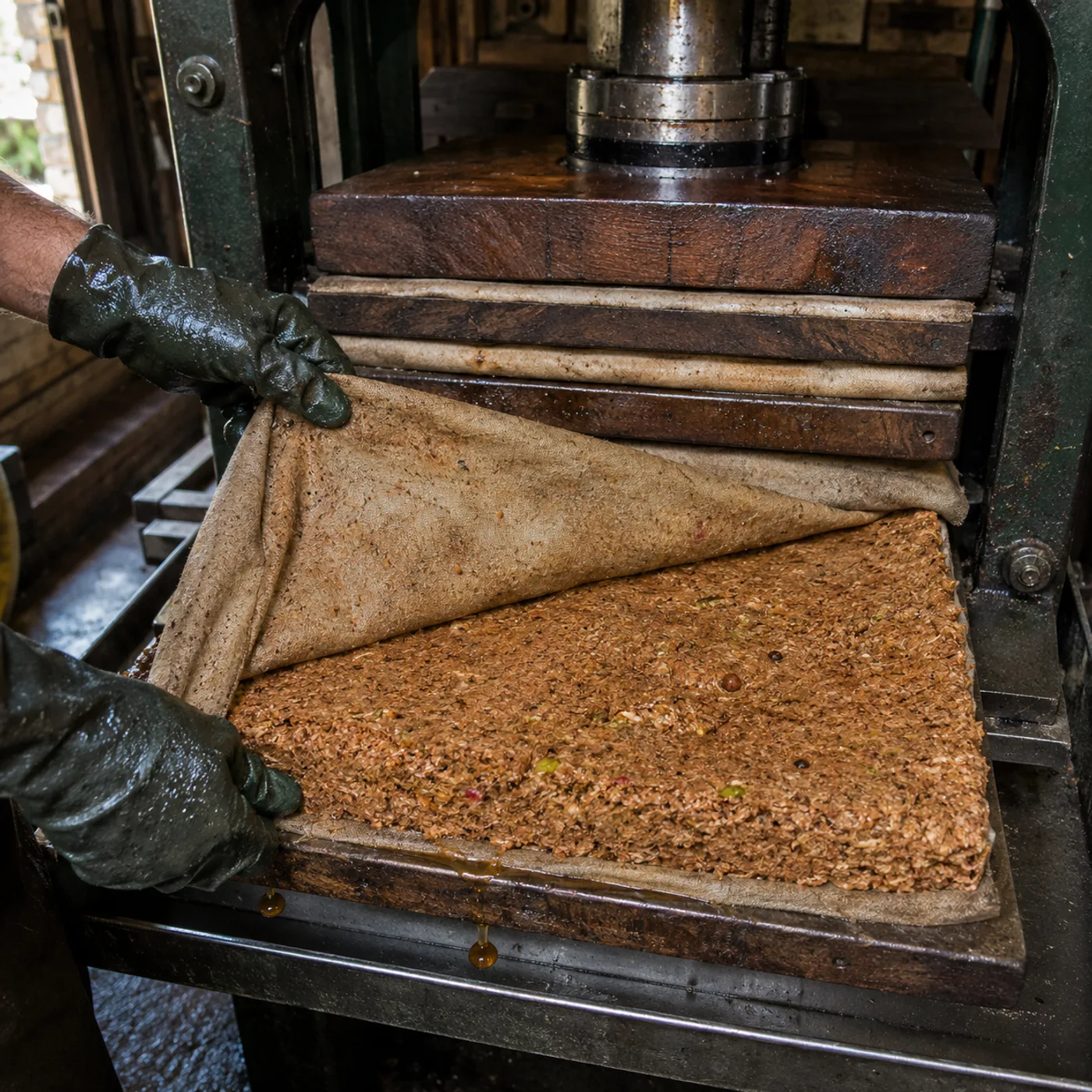
- Rack and cloth
- Low on both axes. The pomace is built into cloth-wrapped layers by hand and pressed slowly; the cheese is a largely sealed stack, so the juice inside meets little air. It gives clean juice and it is the slowest thing in the building.
- Basket and hydraulic
- Both batch methods, both slow, both with the pomace surface exposed while pressure is applied. The hydraulic press is the faster of the two because the pressure is applied mechanically rather than by a screw.
- Bladder
- The lowest air contact of all, because the press is a closed vessel and can be flushed or filled without the juice seeing much oxygen at all. Faster than the batch presses and slower than a belt.
- Belt
- The fastest and the most exposed. Pomace runs continuously between two moving belts through a series of rollers, in the open, in a thin layer with a large surface area. That is the trade: the juice is out quickly and it has met a great deal of air on the way.
- Why there are no numbers
- Throughput and yield figures for presses circulate widely and come almost entirely from manufacturers. CiderHQ has verified none of them and does not reproduce them. What can be defended without a number is the ordering, and the ordering is the useful part: the trade between speed and oxidation is the decision a maker is actually taking.
Why it is used
- Fruit is the largest single cost in most cider production, so the volume of juice recovered from it sets the economics of a season.
- A yield figure tracked across a run is a diagnostic: a fall against the same fruit and settings usually points to a mill going blunt, a press cycle being cut short or cloths that need attention.
- Planning vessel space, buying fruit and forecasting a batch all require an expected recovery, even an approximate one.
- Knowing how much of the recovery came from the hard-pressed final fraction tells a maker something about the juice they are about to ferment, not just about the volume of it.
How it works
- Apple tissue holds most of its liquid in cell vacuoles behind intact walls, so yield depends first on how thoroughly milling ruptures those cells — a coarse or blunt mill leaves juice locked in whole tissue that no pressure will reach.
- Pectin in the cell wall and middle lamella binds water into a gel; where pectolytic enzyme has been used on the pomace, that structure is degraded and water previously held in the gel becomes recoverable.
- Compression reduces pore volume until the remaining liquid is retained by capillary forces at a scale the press cannot overcome, at which point additional pressure produces cake compaction rather than juice.
- Fruit condition sets the ceiling: overripe or long-stored fruit has softened cell walls and often presses to a mush that blinds cloths, while very firm or under-ripe fruit resists rupture at the mill.
- The last juice to leave the press has travelled through the most compacted, most macerated pomace, so it is compositionally distinct from the free run rather than simply more of it.
What it changes
The direction this step pushes the finished drink in, dimension by dimension. A direction, not a measurement: how far it moves depends on the juice, the temperature and how the step is carried out.
| Dimension | Direction | Why |
|---|---|---|
| Phenolic character | Raises | Pushing recovery higher means extracting later fractions that have passed through macerated skin and cell-wall tissue, which carries more phenolic material per unit of juice than the free run does. |
| Astringency | Raises | The additional phenolics recovered at high pressure are weighted towards polymerised procyanidins, which are the fraction most effective at precipitating salivary proteins. |
| Body | Either way | Hard pressing adds pectin and fine solids that increase colloidal load, but where pomace was enzyme-treated to raise recovery that same pectin has already been degraded, so the two effects can run in opposite directions. |
The chemistry and the organisms
What is actually being changed, and by what. Each entry says what that compound or organism does in cider generally; this page is one place it does it.
Compounds involved
Pectin
The structural polysaccharide of fruit cell walls, which decides how much juice a press releases, whether a cider ever clears, and whether keeving is possible at all.
Procyanidins
The condensed tannins of cider fruit, whose chain length — not their quantity — decides whether the mouth registers bitterness or astringency.
Total phenolics
The single number used to summarise everything phenolic in a juice, useful for comparing fruit and misleading whenever it is used to predict how a cider will taste.
Glucose
The sugar yeast takes first and the smallest of the three in apple juice, which is why the last sugar left in a slow ferment is almost never glucose.
Fructose
The dominant sugar of apple juice and the sweetest of the common sugars, which is why apple juice tastes sweeter than its total sugar figure implies and why a stuck ferment leaves sweetness behind.
Malic acid
The acid of apples, which supplies almost all the sharpness a cider has and, through pH, decides how vulnerable that cider is to everything that could spoil it.
What it is done with
Press types compared
A side-by-side account of how the common press types differ in yield, in oxygen exposure, in the phenolic load they put into the juice, in labour and in what they demand of the mill.
Particle size, yield and phenolic extraction
Milling finer raises the juice that can theoretically be extracted and the phenolic load carried into it, but past a point the pomace stops draining and yield collapses — so the right particle size is set by the press, not by the mill.
What can go wrong
Faults that begin at this step, or that this step makes more likely. Each one is set out with its causes and whether it can be put right.
Excessive astringency
A drying, roughening, mouth-puckering sensation that outstays its welcome, produced by larger phenolic polymers precipitating salivary proteins.
Excessive bitterness
Bitterness that dominates the palate rather than supporting it, usually from a blend weighted too heavily towards high-tannin fruit or extracted too hard.
Pectin haze
A persistent, slightly viscous haze that will not settle, caused by pectin from the fruit remaining in solution as a colloid.
Enzymatic browning
The rapid darkening of milled fruit and fresh juice as polyphenol oxidase converts phenolics to quinones, taking colour and some tannin structure with it.
Thin body
A cider with no weight or texture in the mouth, most often from over-watered pomace, low-gravity juice or a blend with nothing to give it substance.
Recorded figures
Shown with the place, period and method each was taken under, and never averaged: the same step run in another cellar genuinely gives a different number.
2 separate analyses of juice yield. They are shown as they were measured, in their own contexts, and are not averaged — the same fruit grown somewhere else can genuinely give a different number.
Juice yield63–825 L/t
WSU Mount Vernon NWREC, Skagit Valley, Washington, USA, 2015–2017 · Juice pressed from 25 fruit per cultivar on a laboratory press, across 44 cultivars. Published in millilitres per pound and converted at 2.204623 pounds to the kilogram. · Washington State University Northwestern Washington Research and Extension Center
The spread across cultivars at one site in one programme, not a comparison of presses. What a press recovers depends on the fruit, on how finely it was milled and on whether the pomace was macerated, and any of those moves the figure by more than the difference between two press types does.
Juice yield545 L/t
WSU Mount Vernon NWREC, Skagit Valley, Washington, USA, 2015–2017 · The median of the 44 cultivar figures in the same programme. A median rather than a mean, because the distribution has a long low tail from a handful of cultivars that yielded almost nothing. · Washington State University Northwestern Washington Research and Extension Center
A median across cultivars at one site, offered as a position in the range rather than as an expectation. CiderHQ publishes no press throughput or yield claim, because the figures in circulation come from equipment marketing rather than from a comparative trial.
How much juice a tonne of fruit gives up, which depends on the fruit and on the press. Measured in litres per tonne.
More on pressing yield
CiderHQ does not publish a headline yield figure, and that is a deliberate refusal rather than a gap. Recovery from the same orchard varies with cultivar and its cell structure, with ripeness and how long the fruit was stored, with how finely and evenly it was milled, with whether pomace was macerated or enzyme-treated, with press type, with the pressure programme and with how long the operator was willing to wait. Any single number quoted without those conditions is being read as a target by people whose conditions differ, and the predictable result is fruit being worked harder than it should be to hit someone else’s figure. Where a source states a yield, it states it for a stated fruit and method; that is the only form in which the number means anything.
The convention used in the arithmetic also needs stating. Juice yield expressed as a mass fraction of the fruit charged is the form used in the gravity and volume calculations that a maker actually needs — estimating how much juice a delivery of fruit will make, and how much of a target batch a given press run represents. Expressed as volume per mass it depends on the density of the juice, which itself rises with sugar content, so the same pressing reported both ways gives numbers that do not correspond in a fixed ratio. Jolicoeur’s handbook sets out the arithmetic convention and works through the calculation; the important discipline is to state which convention a figure uses rather than to quote it bare.
The reason yield is a sensory subject and not only an accounting one is that the fractions are not equivalent. Free run and early pressing are largely vacuolar sap: sugars, malic acid, and the phenolics that were dissolved in it. The final hard-pressed fraction has been squeezed through compacted, torn tissue, and carries proportionally more skin and cell-wall material, more suspended solids and more of the higher-molecular-weight procyanidins. Blended back, it darkens the juice, raises astringency and adds colloidal load; kept separate, it is a component a maker can choose to use or not. Chasing the last few percent of recovery is therefore never a free gain — it is a decision to change the composition of the juice, and it should be made on those grounds.
Related processes
Steps that sit alongside this one, replace it, or depend on it having been done.
Fruit preparation
Milling
Reducing whole fruit to a pulp so that the press has cell walls it can drain, rather than intact apples it can only bruise.
Fruit preparation
Enzyme addition to pomace
Dosing pectin-degrading enzyme into milled pomace rather than into juice, to raise press yield and change how the cake drains.
Pressing
Rack-and-cloth pressing
Building pomace into thin cloth-wrapped layers separated by racks, so that juice has a short path out and the stack can carry the pressure needed to force it.
Pressing
Hydraulic pressing
Pressing in which a pump drives fluid against a ram, so that a small pumped pressure becomes a large, controllable and repeatable load on the pomace.
Pressing
Second pressing and watering
Re-wetting spent pomace and pressing it again to recover a weak second juice — historically the drink of the farm household, and the practice that minimum-juice-content rules now constrain.
Pressing
Pomace handling
What is done with the pressed cake once the juice is off it — feed, pectin extraction, composting, digestion or orchard spreading — and why a wet acidic heap beside the press is a problem.
Where this comes up in a guide
An ordered path that passes through this page, for a reader who wants the sequence rather than the reference.
What people ask next
Questions readers ask about the things this page mentions. Each one goes to the section that answers it rather than to a page written to receive the question.
- How are apples pressed for cider — The fruit is first milled to a pulp, then that pulp is squeezed — traditionally in cloth-wrapped layers under a screw or hydraulic ram, and industrially in a belt or bladder press. Whole apples cannot be pressed usefully; they must be broken first.
- How are apples milled for cider
- What is malic acid and why does it matter in cider — Malic acid is the acid of apples and supplies almost all the sharpness a cider has. It also sets pH, which decides how well sulphite works and how exposed the cider is to spoilage, so it does far more work than its taste suggests.
- Which type of cider press should i use — No press is best. Each one sits at a different point on four trade-offs: how much juice it recovers, how much air the juice meets, how hard it works the solids, and how much labour and capital it needs.
- How do i clear a cloudy cider
- What are procyanidins in cider — They are the condensed tannins of apples: chains of catechin-type units whose length decides how much of the phenolic load reads as bitterness and how much as astringency. Two ciders with identical total tannin can taste nothing alike.
Where to go next
- How cider is made — The whole sequence, stage by stage, with the choices open at each one.
- Cider science — The chemistry and microbiology the methods on this page rest on.
- Troubleshooting — What goes wrong, how to recognise it, and whether it can be reversed.
Sources
What this page rests on. Where a source is marked as registered rather than read, CiderHQ is recording that the body is authoritative on the subject without claiming to have worked through the document itself. See our evidence policy for what each state means.
The New Cider Maker’s Handbook: A Comprehensive Guide for Craft Producers
Claude Jolicoeur, Chelsea Green Publishing, 2013. ISBN 9781603584739 · reference work · bibliographic record verified, not opened 2026-08-25
Bibliographic record verified on 2026-08-25 against the Open Library union catalogue: Chelsea Green Publishing, 2013, ISBN 9781603584739, one edition recorded. That establishes the citation points at a real book in a stated edition, which is what a citation needs and is all it establishes. No copy was opened and nothing is quoted from it. The book itself is in print and not digitised in any open collection; where CiderHQ needs a figure from this territory it uses an accessible research source instead and says so.
Cider and perry production technical training material
Peter Mitchell / Cider and Perry Academy · reference work · registered as competent for this subject
Searched again on 2026-08-25 and it remains the one printed source here that a bibliographic check cannot fix, because it is not a published work with an edition. It is course material issued to participants of a training programme, so there is no catalogue record to verify, no ISBN, and no lawful public copy. Its state stays `registered` for that reason rather than through inattention.
The Science of Cidermaking and associated technical writing
Andrew Lea · reference work · passage verified 2026-08-24
Written by a food chemist who worked at Long Ashton on apple phenolics. Unusual among specialist cider writing in that it is primary-research-adjacent: the author is describing work he did, and cites the literature. This is why it is registered at tier 1 for chemistry while a general cider book is not.