Making
Cider making equipment
Very little cider equipment is specific to cider. What matters is what each piece does to the fruit or the juice — and that is a question about mechanism, not about brand.
Cider can be made with a kitchen blender and a demijohn, or with a belt press running twenty tonnes an hour into temperature-controlled stainless. The steps in between are the same steps. What changes with scale is how much control the maker has, how much oxygen the juice sees, how fast the fruit is worked through, and what a mistake costs — not what is happening chemically.
Some equipment choices genuinely change the drink rather than the convenience of making it. How finely the fruit is milled sets how much tannin is extracted; how long the pomace stands before pressing sets how much more; a wooden vat carries a microbial population a stainless tank does not; a press that works slowly at low pressure gives a different juice from one that squeezes hard and fast. Those differences are noted on each page, and separated from the ones that are only about throughput.
For what the equipment is used to do, see how cider is made; for the chemistry and microbiology it acts on, see cider science.
Described in full
- Shape
- A two-axis plot. The horizontal axis runs from little air contact on the left to a great deal on the right; the vertical axis runs from slow at the bottom to fast at the top. Five presses are plotted as marks: circles for batch presses, a circle in a different fill for the closed bladder press, and a diamond for the continuous belt press.
- Rack and cloth
- Low on both axes. The pomace is built into cloth-wrapped layers by hand and pressed slowly; the cheese is a largely sealed stack, so the juice inside meets little air. It gives clean juice and it is the slowest thing in the building.
- Basket and hydraulic
- Both batch methods, both slow, both with the pomace surface exposed while pressure is applied. The hydraulic press is the faster of the two because the pressure is applied mechanically rather than by a screw.
- Bladder
- The lowest air contact of all, because the press is a closed vessel and can be flushed or filled without the juice seeing much oxygen at all. Faster than the batch presses and slower than a belt.
- Belt
- The fastest and the most exposed. Pomace runs continuously between two moving belts through a series of rollers, in the open, in a thin layer with a large surface area. That is the trade: the juice is out quickly and it has met a great deal of air on the way.
- Why there are no numbers
- Throughput and yield figures for presses circulate widely and come almost entirely from manufacturers. CiderHQ has verified none of them and does not reproduce them. What can be defended without a number is the ordering, and the ordering is the useful part: the trade between speed and oxidation is the decision a maker is actually taking.
CiderHQ names no brands, ranks no suppliers and carries no affiliate links. These pages describe how a class of equipment works and what it does to the cider. Anything to do with pressure ratings, food-contact materials, electrical safety or cleaning-chemical handling is the manufacturer’s and your regulator’s to specify, not ours.
Milling and handling fruit
Getting the fruit clean, sorted and broken down into something a press can work with.
Farm mill and commercial plant: what changes with scale
A farm mill is a scratter, a pack press, a row of vessels and a cold building; a commercial plant adds continuous handling, temperature control, clarification, a packaging line and the analytical and hygiene systems that make consistency and compliance possible.
The apple washer and the flotation tank
Cider fruit is gathered off the orchard floor, so it arrives with soil, grass, stones and rot attached; a flotation tank separates the fruit from the stones by density alone, and a spray or brush stage takes off what floating will not.
The hammer mill
A high-speed mill in which swinging hammers on a rotor smash fruit against a breaker plate and force it through a screen, producing a fine, uniform pomace suited to belt and continuous pressing.
The scratter
A roller mill that tears apples into coarse pomace between toothed or spiked rollers, the machine that replaced the stone mill on most farms and still the commonest mill at small and medium scale.
The stone circular mill and horse gin
A circular stone trough in which a heavy edge-runner stone, dragged round by a horse, crushed apples slowly over an hour or more — the standard English farm mill from the seventeenth century until the scratter displaced it.
Elevators, conveyors and hoppers
Fruit moves by gravity where the building allows it and by flume, belt, bucket elevator or auger where it does not; each method bruises the fruit to a different degree, and each is a machine capable of drawing a person into it.
Hand mills and small-scale milling
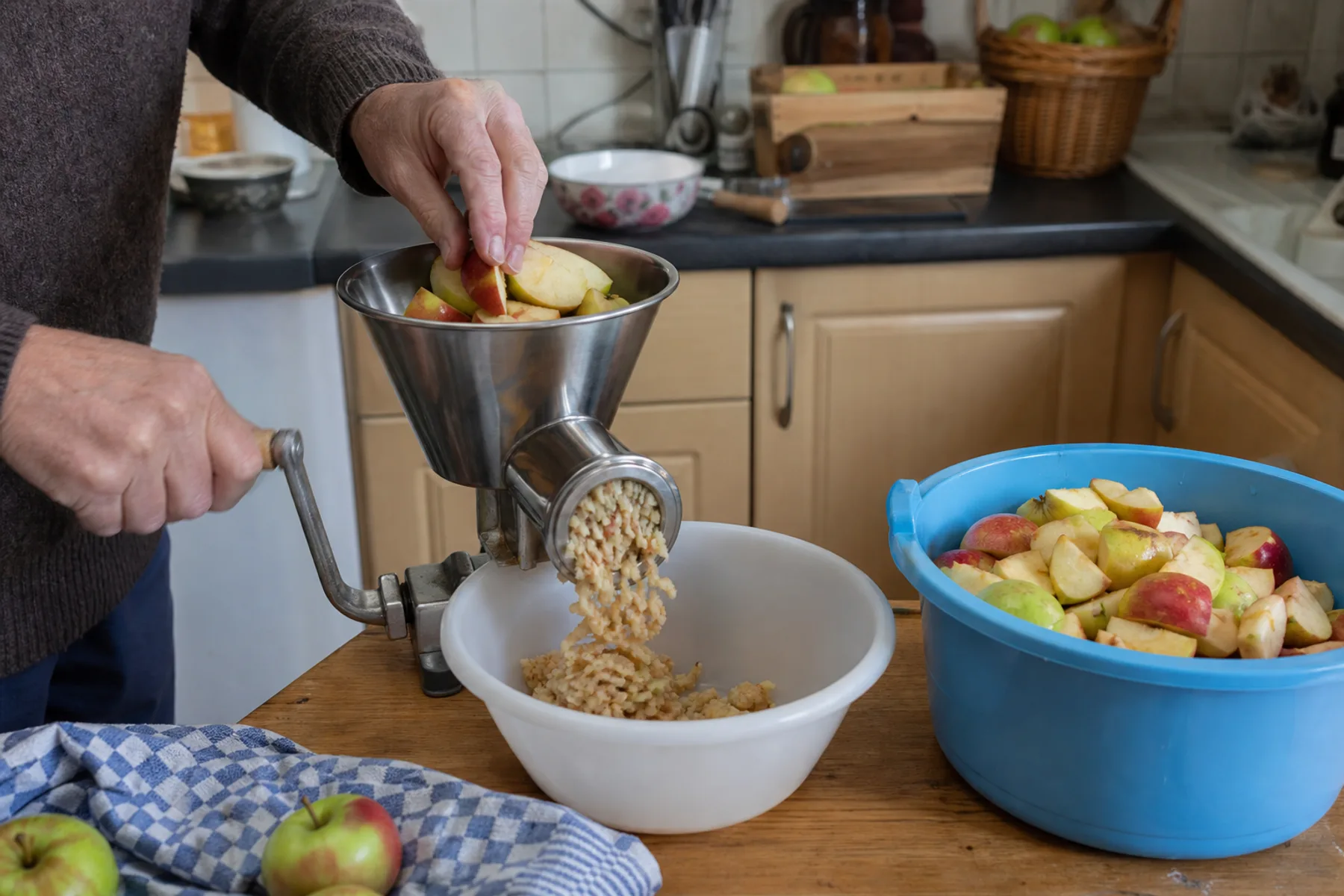
Hand-cranked roller mills, drill-driven grating mills, and the improvised methods — freezing, chopping, a clean baulk of timber in a tub — that people use for the first few batches, with an honest account of how much work each is.
The centrifugal mill
A mill in which fruit is thrown outwards by a rotating disc or drum against a serrated ring or grating surface, cutting rather than smashing it and giving an unusually even particle size.
Bulk bins, crates and pallets
Fruit arrives in sacks, crates or bulk bins, and the container decides how deep the fruit sits, how well it breathes, how long it can wait and how it will be tipped — which makes it a quality decision as well as a handling one.
Pressing
The machines that separate juice from pomace, and what each does to the yield and the tannin.
Press types compared
A side-by-side account of how the common press types differ in yield, in oxygen exposure, in the phenolic load they put into the juice, in labour and in what they demand of the mill.
The rack and cloth press
A press in which pomace is built into a stack of thin cloth-wrapped layers separated by rigid racks, so that juice has a short path to a free edge at every level — the highest-yielding batch press for traditional coarse pomace.
The basket press
A slatted cylindrical cage filled with pomace and compressed by a plate driven down by a screw or a small hydraulic ram; simple, cheap and forgiving, but limited in yield because juice at the centre has a long way to travel.
The beam press, the screw press and the twin screw
Timber-framed presses that applied force by a weighted lever beam or by one or two hand-turned wooden or iron screws, the standard farm press in England and France for centuries and still in use.
The bladder or pneumatic press
A press in which a rubber membrane is inflated with compressed air inside a perforated or channelled drum, squeezing pomace outward against the drainage surface with a low, even, gentle pressure.
Press cloths, from hair cloth to synthetics
The cloth that wraps each layer of pomace has to pass juice, hold back solids and survive repeated full pressure; horsehair and coarse hemp gave way to woven polypropylene and nylon, which are stronger, cleaner and easier to sanitise.
The belt press
A continuous press in which mash travels between two porous belts through a series of rollers of decreasing gap, squeezing juice out sideways; very high throughput and very high oxygen exposure.
The pomace belt, and what becomes of pomace
Pressed cake leaves a modern press on a belt or an auger and goes to stock feed, to land, to anaerobic digestion or to pectin extraction; on a farm it usually goes to cattle or back on the orchard, and neither is as simple as it is usually described.
The continuous screw press
A tapering auger turning inside a perforated cage that conveys mash forward while progressively reducing its volume, forcing juice out through the screen; high throughput and high shear, usually reserved for volume and for second pressings.
Fermentation vessels
What the cider ferments and sits in — the choice that keeps working on the drink for as long as it is in there.
Choosing a fermentation vessel: material and shape
Vessel material decides oxygen ingress, flavour contribution and how well the thing can be cleaned; vessel shape decides temperature behaviour, lees depth and how much surface the cider presents to whatever is above it.
Plastic vessels and what "food-grade" actually means
High-density polyethylene and polypropylene vessels made and certified for food contact are entirely suitable for fermenting cider; the question is never "is it plastic" but "was this container made and used for food".
Stainless steel tanks
Stainless steel is inert, effectively impermeable to oxygen, and the only common vessel material that can genuinely be cleaned and sanitised — which is why it displaced wood almost completely in commercial cider making.
Airlocks, bungs and headspace management
An airlock is a one-way water trap that lets carbon dioxide out of a vessel while keeping air, insects and dust from coming in — a small component that solves the largest single problem in small-scale cider making.
Casks, barrels and the ex-spirit trade
Second-hand spirit and fortified-wine casks were abundant, cheap and already watertight, so they became the default cider vessel across the West Country and beyond — bringing a residual spirit character with them.
Glass demijohns and carboys
Glass is inert, impermeable, transparent and cleanable, which is why it performs so well as a small-scale fermenter — offset by weight, fragility and a batch size that stops being convenient somewhere around twenty-five litres.
Juice reception and settling tanks
A reception tank takes juice as fast as the press makes it so the rest of the plant can work at its own pace, and a settling tank then holds it still and cold while the gross solids fall — the cheapest clarification available to anyone.
Oak vats and wooden tuns
Large upright vats of oak or chestnut were the standard fermentation vessel of the farm cider house for centuries; they breathe, they hold a resident microflora, and they are almost impossible to sterilise.
The cleaning problem posed by wood
Wood is porous, scored and chemically vulnerable, so it cannot be sanitised the way stainless can; wooden vessels are managed by keeping them wet, full and cool, by hot water and physical cleaning, and by accepting that some casks are past saving.
The floating lid and the variable-capacity tank
A floating lid is a disc that rests on the surface of the cider and seals against the tank wall with an inflatable gasket or a liquid-filled channel, so a part-full vessel carries no headspace at all — which is the only problem the design exists to solve, and a large one.
Concrete and stone vats
Concrete tanks give a wooden vat’s thermal steadiness and a steel tank’s indifference to flavour, provided the interior is lined or well passivated — and they are effectively permanent, for better and worse.
Measuring and testing
The instruments that tell you what is happening, and what each of them can and cannot tell you.
The hydrometer and the trial jar
A weighted glass float that sinks to a depth set by the density of the liquid, read against a scale on its stem; with a starting and a finishing reading it gives the sugar consumed and an estimate of alcohol produced.
The pH meter and its calibration
A pH meter reads the activity of hydrogen ions through a glass electrode, giving the number that governs microbial safety and sulphur dioxide effectiveness — and it is worthless without regular calibration and proper probe storage.
Laboratory measurement versus practical measurement
Gravity, temperature, pH and total acidity are all within reach of a careful person with modest equipment; alcohol by volume, sulphur dioxide for a declaration, patulin, methanol and microbiological counts are not, and pretending otherwise is how numbers on labels become wrong.
Measuring sulphur dioxide
The reference method is aeration-oxidation, which strips sulphur dioxide out of an acidified sample and traps it for titration; the quicker Ripper method titrates the sample directly with iodine and over-reads in cider because other substances react too.
The refractometer, and why it lies during fermentation
A refractometer measures how much a liquid bends light, which tracks dissolved sugar closely in juice and needs only a drop of sample — but ethanol bends light too, so once fermentation starts the reading is no longer a sugar measurement.
Titration kits for total acidity
Total acidity is measured by titrating a measured sample with a standard alkali until all the acid is neutralised, and reading off how much alkali it took — a cheap, reliable measurement whose main pitfall in cider is finding the endpoint in a coloured liquid.
Dissolved oxygen meters
A dissolved oxygen meter reads the oxygen actually in the liquid, using either an electrochemical membrane cell or an optical sensor whose luminescence is quenched by oxygen — the only instrument that turns an argument about oxygen pickup into a number.
Drawing a sample without spoiling the batch
Every sample is a small hole made in the protection around a batch: something goes in, air goes in with it, and cider comes out — so the technique is about drawing a representative sample while putting nothing back and letting in as little air as possible.
Thermometers and temperature measurement
Temperature drives fermentation rate, yeast stress and the aromatic compounds that result, and the only reading that means anything is one taken in the liquid — not on the outside of the vessel and not in the room.
Moving and clarifying liquid
Pumps, hoses, racking gear and filtration — everything between one vessel and the next.
Filters: plate, sheet, cartridge and crossflow
Filtration ranges from coarse polishing that only brightens a cider to sterile membrane filtration that removes yeast and bacteria entirely; the equipment differs in whether it traps particles in a depth of material or on a surface, and in what it takes out of the cider along with the haze.
Pumps, and what a rough pump does to cider
A pump that shears, cavitates or draws air changes the cider it moves — stripping carbon dioxide, dissolving oxygen and breaking up lees — so the choice between centrifugal and positive-displacement types is a quality decision, not only an engineering one.
Siphons, racking canes, hoses and food-grade tubing
A siphon moves cider under gravity with no moving parts and no shear, which is why it remains the small-scale racking method of choice; the tubing it runs through must be food-grade, and it is the hardest thing in the cider house to clean.
Riddling racks, freezing baths and the disgorging bench
Cider fermented a second time in the bottle has to have its sediment collected in the neck, frozen into a plug and expelled, which needs a riddling rack or a gyropalette, a chilled bath, and a bench arrangement for disgorging, topping up and closing.
The centrifuge
A centrifuge separates solids from liquid by spinning them at high speed, clarifying juice or cider in a single continuous pass without filter aid — fast, effective, expensive, and capable of doing real damage if it draws air.
Packaging
Bottles, kegs, boxes and closures, and the pressure each is built to hold.
Bottles and pressure: what glass will and will not hold
Sparkling-wine bottles are engineered and tested to hold several atmospheres; still-wine bottles are not engineered to hold any, and filling one with a carbonating cider is the most dangerous ordinary mistake in home cider making.
Bottling lines and fillers, small and large
Filling is where a finished cider is most exposed: oxygen picked up in the last two minutes can undo a year of care, and carbonated product needs a filler that keeps it under pressure until the closure is on.
Carbonation stones and in-line carbonation
Forced carbonation dissolves carbon dioxide into cider under pressure, either by feeding it through a sintered stone in a chilled pressure-rated tank until the cider approaches equilibrium, or by metering it into a moving stream on the way to the filler.
Counter-pressure filling
Carbon dioxide stays dissolved only under pressure, so carbonated cider poured into an open bottle foams, loses its gas and takes on air; a counter-pressure filler removes the pressure difference by purging and pressurising the bottle first, and vents it under control at the end.
Crown caps, swing tops and the tools that fit them
The crown cap is a crimped steel cap with a compressible liner, the cheapest reliable pressure closure ever devised; the swing top is a reusable stopper held by a wire bail, convenient and dependent entirely on the condition of its gasket.
Kegs, couplers and dispense
A keg is a stainless or composite pressure vessel with a valve and a dip tube; gas pushes the cider up and out, and the coupler is what connects the dispense line to a particular design of valve.
Bag-in-box and canning
Bag-in-box collapses as it empties so no air replaces the cider, which suits still cider dispensed over days; canning excludes light and oxygen completely but depends entirely on a correctly formed double seam and a liner that resists an acidic drink.
Corks, agrafes and muselets
A sparkling closure is a cork compressed to a fraction of its diameter and driven into the neck, held there by a metal clip during conditioning or by a wire muselet once finished — because the pressure inside would otherwise push it out.
Labelling machines and date coding
Labels are applied by hand, by a wet-glue machine or by a pressure-sensitive applicator, and every pack also carries a lot code from an inkjet, a laser or a hand stamp — because a batch that cannot be identified cannot be withdrawn.
Cleaning and sanitation
The least visible equipment and the one most faults are traced back to.
Sanitation: clean, sanitised, and why it decides the batch
Cider is an unsterile liquid at a pH and alcohol level that many spoilage organisms tolerate, so what survives on the equipment goes into the batch — which makes hygiene the largest single determinant of whether a small-scale ferment turns out drinkable.
Caustic and acid cleaning
Alkaline cleaners dissolve organic soil — fats, proteins and the residues of fermentation; acid cleaners dissolve mineral soil such as tartrate and calcium scale, and restore the passive layer on stainless steel. Both are hazardous chemicals used under the supplier’s own instructions.
Peracetic acid and other sanitisers
Peracetic acid is the commonest commercial sanitiser in beverage work because it is a powerful oxidant that breaks down to acetic acid, water and oxygen; the alternatives — acid-anionic, iodophor, hot water, steam and ozone — each have their own place and their own hazards.
Cleaning in place
Clean-in-place circulates cleaning and sanitising solutions through closed vessels and pipework at a controlled temperature, concentration and flow, so that equipment too large or too enclosed to be reached by hand is cleaned reliably and repeatably.
Scale
What changes between a kitchen, a shed and a working cidery — and what does not.
Everything else
Inert gas: carbon dioxide, nitrogen and argon
Gas is used to push air out of tanks, bottles, kegs and lines, and the three common gases are not interchangeable: carbon dioxide dissolves readily and will carbonate a cider, nitrogen barely dissolves at all, and argon is heavy enough to lie on a surface.
Calibration: instruments as things that need maintaining
Every instrument in a cider house drifts, and what keeps its numbers worth having is maintenance rather than technique — a zero check against a known standard, a temperature correction applied every time, and a record of when each was last done.
Improvising: what genuinely substitutes and what does not
A great deal of cider equipment has a sound domestic substitute and some has none; the line runs between things that are only shapes — a vessel, a tube, a jar — and things that are specifications, such as a pressure-rated bottle or a food-contact plastic.
Maintenance and the off-season
Cider equipment works for a few weeks and stands for eleven months, which is the opposite of what most machinery is designed for; what fails is almost always what was put away wet, put away dirty, or left dry when it should have been kept wet.
Particle size, yield and phenolic extraction
Milling finer raises the juice that can theoretically be extracted and the phenolic load carried into it, but past a point the pomace stops draining and yield collapses — so the right particle size is set by the press, not by the mill.
Temperature control: glycol, coils and a cold room
Cooling can be applied to the vessel — a glycol jacket or a coil in the liquid — or to the air around it, and for most small producers a cold room, an insulated container or simply a cold building is the cheaper and more reliable answer.
Heat exchangers and chilling the juice
A heat exchanger puts two liquids either side of a thin wall so heat crosses and the liquids do not mix; in a cider house the same machine chills warm press juice, holds a tank at temperature, and carries out flash pasteurisation.
Hydraulic packs and rams
The pump, reservoir, valves, hoses and ram that turn a small electric or hand effort into tonnes of force at a press platen — the component that made high-yield batch pressing practical, and the one that stores the most energy.
The *llagar* and the Asturian *tonel*
In Asturias the llagar is the cider house and, by extension, the press within it; fermentation happens in very large upright chestnut or oak casks — toneles or pipas — which shape the character of sidra natural.
Next
- How cider is made — the methods this equipment exists to carry out.
- Troubleshooting — the faults that come from equipment and from cleaning, and how to tell them apart from fruit faults.
- Tools and calculators — gravity, dilution and blending arithmetic, worked in the browser.