Learn
The history of cider
Cider has been a peasant drink, a gentleman's project, a currency paid to farm labourers, a cause of mass lead poisoning and a national industry — usually more than one of those at a time.
The history of cider is unusually badly served by its popular version. Almost every general account repeats the same handful of claims — that the Romans found the Britons drinking it, that the Normans brought the orchards, that Johnny Appleseed was planting eating apples — and almost none of them says which of those the evidence supports. Some are probably true, some are demonstrably later inventions, and a few are the kind of story that gets repeated precisely because nobody has gone back to check.
These pages separate the three. Where a claim rests on a document, the document is named. Where it rests on a tradition first written down centuries after the event, that is said. Where the honest answer is that nobody knows, the page says so rather than choosing the more attractive possibility, and the timelines mark every entry as established, probable or contested.
For the customs that came out of this history and are still practised, see cider culture; for the places, see regions.
Described in full
- What this is
- An ordered list of fourteen anchor events, drawn as a vertical spine with a dated marker and a heading for each. It is a shape rather than a record: sixty-six history topics carry their own dated timelines, and this exists to show how they sit relative to one another.
- Ordered, not to scale
- The vertical spacing is even and the intervals are not. Two thirds of the entries fall after 1600, and a linear axis would compress the entire medieval record into a few millimetres while implying a precision the early dates do not carry.
- Three threads, by colour
- Entries are toned by what they belong to. The documentary record — cider appearing in manorial rolls, the Redstreak boom, the founding of the commercial industry — is one thread. Cider as a scientific subject is a second: the Royal Society, Devon colic, Long Ashton, the modern revival of research. Losses are the third: the decline of the great orchards, Prohibition, the postwar grubbing-up grants.
- First to fifth centuries CE
- Apples are present on Roman-period British sites and cider is absent from the record. The popular claim that the Romans brought cider to Britain rests on ambiguous vocabulary rather than evidence.
- Twelfth to sixteenth centuries
- Monastic, manorial and tithe records begin naming cider, presses and orchard fruit. This is where the documentary history actually starts.
- c. 1620–1720
- The Redstreak boom: a named cultivar and a wave of orchard improvement that made cider a gentleman’s subject as well as a farm product.
- 1657–1691
- The first cider literature, including the Pomona appended to Evelyn’s Sylva — the point at which cider making is written down rather than only practised.
- 1660–1680
- The Royal Society takes cider as a subject of investigation, which is the beginning of cider as something studied rather than only made.
- c. 1630–1800
- Cider becomes the ordinary farm drink of colonial America, on a scale and for reasons quite separate from the English trade.
- 1763–1766
- The Cider Bill extends excise to cider and provokes sustained resistance in the cider counties. Regulation and cider have been entangled ever since.
- Seventeenth to nineteenth centuries
- Devon colic — endemic lead poisoning traced to lead in presses and vessels. One of the earliest occasions on which analysis of a drink changed how it was made.
- c. 1700–1880
- The great orchards decline, through agricultural change, enclosure and the long depression at the end of the period.
- c. 1870–1930
- The commercial cider industry is founded: factory production, national brands and a supply chain separate from the farm.
- 1903–2003
- The National Fruit and Cider Institute, later Long Ashton Research Station — a century of systematic cider research, and the source of a large part of the measured evidence on this site.
- 1920–1933
- Prohibition, and the felling of American cider orchards whose consequences for cultivar survival outlast the law by a century.
- c. 1950–1990
- Postwar grubbing-up grants pay for orchard removal across England, the largest single loss of standard-tree orchard in the record.
- 1990 to the present
- Revival: renewed small-scale production, the recovery of lost cultivars, and the return of published research after the closure of Long Ashton.
- What it leaves out
- Everything undated. The site holds 383 timeline entries and several are explicitly unplaceable — "Prehistory, undated" and "Various claimed antiquities" are entries whose point is that the date is not known. They are recorded on their own pages rather than given a false position here.
Before cider was cider
The apple itself, the first fermented apple drinks, and how much of the ancient record is really about cider at all.
Malus sieversii and the origin of the apple
How genomic work established the wild apple of the Tian Shan as the domestic apple’s principal ancestor, and why the European crab apple’s later contribution matters for cider fruit.
The arrival of cider apples in Britain
How fruit grown specifically for cider came to Britain, why the introductions cannot be dated precisely, and what cultivar naming reveals about the exchange with northern France.
The first fermented apple drinks
Why the earliest fermented apple drinks cannot be dated, what wild fruit and spontaneous fermentation make near-certain, and why "the first cider" is not an event archaeology can find.
The Romans and cider in Britain
Examines the frequently repeated claim that the Romans brought cider to Britain or found it there, and explains why the evidence does not support it.
Apples in the ancient world
What Greek and Roman writers record about apples, grafting and fermented fruit drink, and why the evidence for a substantial classical cider culture is weak.
Where the word cider comes from
Traces cider from a Semitic word for strong drink through Greek and Latin biblical usage into Old French, and explains how a general word for intoxicating drink narrowed to mean fermented apple juice.
The medieval orchard
Cider as an estate crop, recorded because someone was owed a share of it.
Cider in the medieval West Country economy
How cider and perry fitted into the mixed farming of western England and the Welsh Marches, why production concentrated there, and what had changed by the sixteenth century.
Monastic orchards and cider
What religious houses contributed to medieval cider and perry, why monasteries dominate the surviving record, and what the Dissolution actually changed.
The Norman Conquest and cider
What the Norman Conquest plausibly did for cider in England, what it certainly did not do, and how to separate the evidenced from the inferred in a much-repeated claim.
Cider in manorial and tithe records
How cider and perry appear in medieval and early modern English documents, what estate accounts, tithe disputes and probate inventories can establish, and where the record misleads.
The seventeenth-century boom
The one period when cider was a subject of serious experiment, and the fruit and the bottle that came out of it.
Early glass bottling and sparkling cider in England
Strong English glass and cork allowed cider to be bottled before fermentation had finished, producing a sparkling drink in the seventeenth century — and the popular version of that story overstates it.
The Redstreak and the seventeenth-century cider boom
How one Herefordshire cider apple became the centre of a mid-seventeenth-century enthusiasm for cider, and how much of the story is documented rather than repeated.
The cider literature of the 1650s to 1670s
Beale, Evelyn and Worlidge produced the first substantial technical writing on cider in English, and their books are arguments as much as manuals.
The Royal Society and cider
Why the earliest organised experimental science in England devoted sustained attention to cider, and what that reveals about the drink’s status in the 1660s.
Wages, duty and scandal
Cider as part of the agricultural wage, the excise crisis it caused, and the poisoning that ran for a century before anyone identified it.
Cider as part of the agricultural wage
For centuries farm labourers in the West Country and the Welsh Marches were paid partly in cider, a practice that shaped orchards, drinking and the labour relation itself.
Devon colic and lead in cider
An endemic and often disabling illness in the cider counties of the south-west was traced in the eighteenth century to lead in cider-making equipment, in one of the earliest sustained investigations of an environmental cause of disease.
The Cider Bill of 1763 and the excise crisis
A tax on cider charged at the point of making provoked riots across the western counties and a constitutional argument about the right of officials to enter a private house.
The history of duty on cider in Britain
Cider has been taxed, untaxed and taxed again over four centuries, and the way it is charged has mattered more than the rate on several occasions.
The truck system and the end of payment in cider
Payment in kind was legislated against across the nineteenth century, but agricultural cider allowances survived the law by decades — and the reasons why are the interesting part.
Cider and enclosure
Enclosure reorganised the English countryside between the sixteenth and nineteenth centuries, and its effect on orchards and on access to fruit was uneven rather than uniformly destructive.
Decline and reinvention in Britain
From the collapse of the great orchards to the modern industry, by way of Long Ashton, two wars and a grubbing-up grant.
Cider since the 1990s
Two unrelated things happened to cider in the same thirty years: a marketing-driven boom in flavoured and over-ice products, and a small revival of orchard-based cider. They are separate stories.
Concentrate and the changing definition of mass-market cider
Apple juice concentrate decoupled cider from the harvest and from the orchard, and the minimum juice content set in duty law defines how far that decoupling may go.
Grubbing-up grants and the clearing of the orchards
Post-war agricultural policy paid farmers to remove standard orchards, and the arithmetic behind those decisions was sound even where the outcome was a landscape emptied of trees.
The founding of the commercial cider industry
How cider stopped being something a farm made for itself and became something a factory bought fruit to produce, between roughly 1870 and 1930.
The National Fruit and Cider Institute and Long Ashton
From 1903 a research station in Somerset gave the cider industry the science it had never had, and its closure a century later left a gap that has not been filled.
Where the bittersweet classification came from
The English four-way division of cider apples was a twentieth-century blending tool built on two measurements, and understanding what it was for explains what it cannot do.
The decline of the great orchards
Between the early eighteenth century and the late nineteenth, English cider lost its status, its market and much of its planted acreage, for reasons that were mainly economic.
The Long Ashton breeding programme
A cider company-funded programme at a university research station raised 1,500 seedlings from four crosses and named the survivors after women. Fifty years later a genotyping study recovered which cross each came from.
The shift from standard to bush orchards
Dwarfing rootstocks turned the cider orchard from a grazed field of large trees into a dense, machine-managed block, and changed the landscape, the ecology and the fruit supply with it.
Cider and the Victorian agricultural depression
The collapse of British farm incomes from the 1870s hit the mixed farms of the cider counties hard, and pushed some of them towards fruit as a way out.
How cider fruit came to be picked by machine
Cider apples are gathered from the ground rather than picked from the tree, which made them one of the first fruit crops to be harvested mechanically — and reorganised the orchard floor to suit.
Orchards and cider in the two world wars
Two wars put opposite pressures on cider: a shortage of everything needed to make and sell it, and a farm workforce whose customary drink the state had reason to leave alone.
The railways and the cider trade
Rail transport turned cider from a drink consumed within a few miles of its orchard into a product with a national market, and concentrated its making in a handful of rail-served towns.
The history of perry
A separate drink with a separate decline, and a fruit that made both inevitable.
The history of perry
Perry has been made in the Three Counties and the Welsh border for at least five hundred years, from pears grown on trees that outlive the people who plant them.
The perry revival
Perry came close to ending as an orchard product in the third quarter of the twentieth century; what reversed it was survey, propagation, legal designation and a small specialist market, in that order.
Why perry declined
Perry contracted further and faster than cider because the trees were slow, the picking window narrow, the juice difficult and the labour it required disappeared — and then the word was taken from it.
Cider in North America
How the most widely drunk alcoholic drink in colonial America became a word for unfermented juice.
Cider in colonial America
Why fermented apple juice became the ordinary drink of the northern American colonies, and what that meant for farms, households and orchards.
Johnny Appleseed, and what the story actually was
John Chapman planted seedling apple nurseries ahead of settlement in the Ohio country and sold the trees; the fruit was mostly for cider, and the barefoot saint of the schoolbooks is a later construction.
Why ‘cider’ means unfermented juice in America
The word split in the nineteenth century: temperance pressure, pasteurisation and refrigeration gave the United States an unfermented drink called cider, and the fermented one had to be renamed.
Prohibition and American cider orchards
National Prohibition removed the legal market for fermented cider, but the orchards had been changing for decades and the axe-wielding federal agent of popular memory is largely a myth.
Temperance and the reclassification of cider
American temperance began by attacking spirits and largely tolerating cider, then turned against it — with consequences for farm orchards and for what an orchard was understood to be for.
The North American cider revival
From the 1990s a fermented cider industry was rebuilt in the United States and Canada, largely from scratch, and split almost immediately into two quite different businesses.
The continental and Nordic traditions
Asturias, the Basque Country, Normandy, Hessen, the Mostviertel and the north, each written from inside its own history.
The history of Asturian sidra
How cider became the defining drink of Asturias, what the llagar was as a building and an institution, and which parts of the region’s cider story the record actually supports.
The history of Norman cider
Northern France turned from vines to orchards across the late medieval and early modern centuries, and Normandy became the largest cider region in Europe.
The history of Apfelwein in Hessen and Frankfurt
How a wine region became an apple region, and how Apfelwein became the civic drink of Frankfurt, with its own vessels, its own quarter and its own meadow orchards.
The history of Basque cider
Basque cider is documented in town ordinances and shipping records from the late medieval period, and it is also the subject of one of the most repeated overstatements in cider history.
The history of Calvados
Cider brandy has been distilled in Normandy since at least the sixteenth century; the name Calvados is a nineteenth-century borrowing from an administrative department.
Cider in the Nordic countries
A short and largely industrial history, shaped by the northern limit of apple growing and by state alcohol monopolies rather than by a long agrarian tradition.
The history of Most in the Austrian Mostviertel
A Lower Austrian district built its farming around pear meadow orchards, made Most the household drink, lost most of the trees in the twentieth century and rebuilt part of the landscape as a conservation and regional project.
How the fruit came to be classified
Classification is a historical artefact of the places that invented it, which is why the schemes disagree.
Objects, custom and landscape
The press, the glass, the wassail and the orchards themselves.
Orchard loss and the conservation response
Traditional orchards contracted sharply across the twentieth century; mapping them, recognising them as a habitat and conserving their cultivars is a recent and still incomplete response.
The history of wassailing
Orchard wassailing is a documented English custom with a Germanic drinking greeting at its root, a seventeenth-century paper trail, and no evidence for the pre-Christian origin routinely claimed for it.
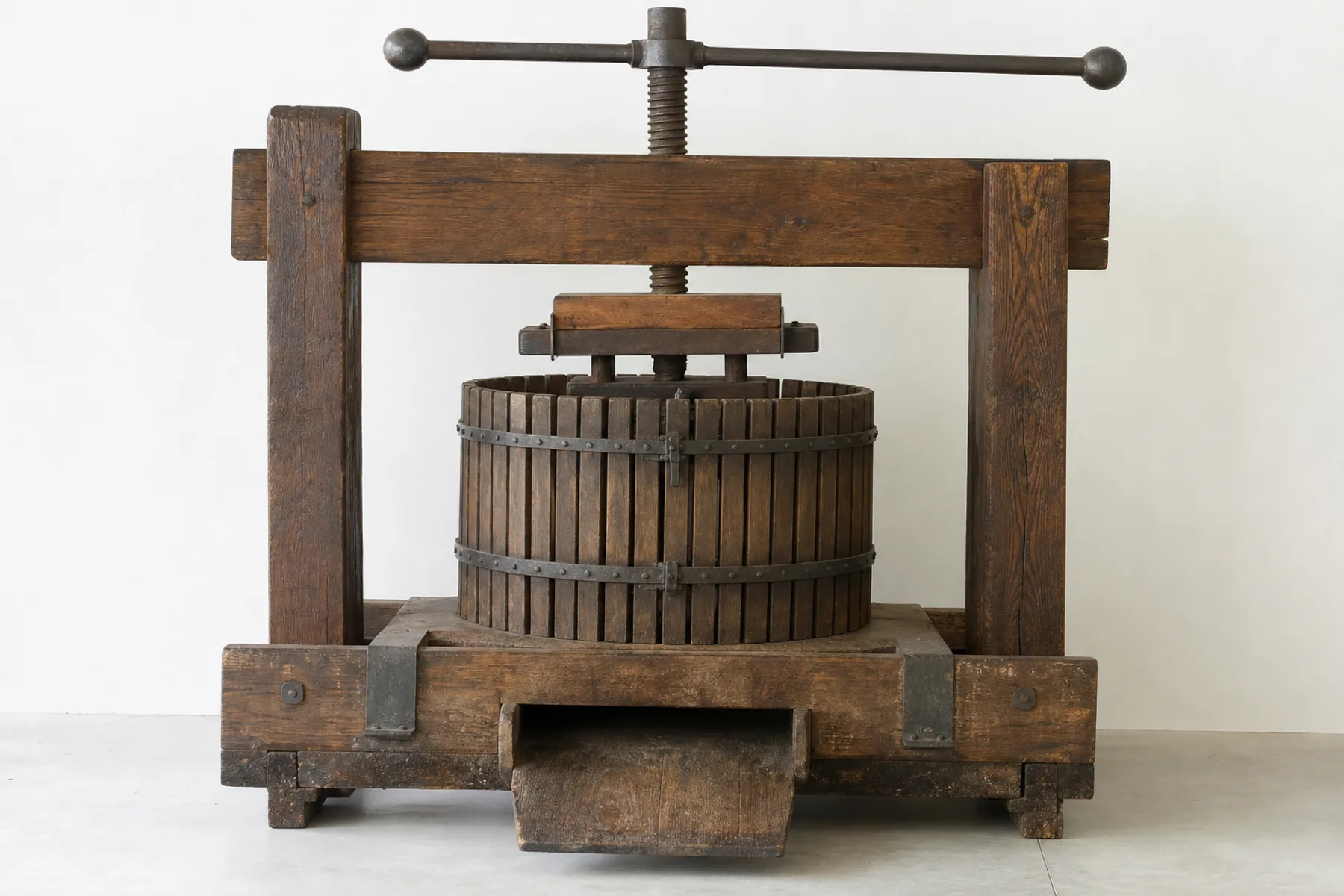
The history of the cider press
From the stone horse mill and beam press to the hydraulic, belt and pneumatic presses of the twentieth century, and what each change bought in yield, labour and juice quality.
The history of cider vessels and glassware
What cider was carried, kept and drunk from — costrel, horn, cask, bottle and glass — and what those vessels reveal about who was drinking it and where.
Everything else
Lost and rediscovered cider varieties
What it means for a grafted variety to be lost, how searching for survivors actually works, and why a rediscovery is usually a well-supported hypothesis rather than a closed case.
Pomology and the identification of apples
How the description, illustration and naming of fruit varieties became a discipline between the late eighteenth and late nineteenth centuries, and what changed when identification stopped being a matter of the trained eye.
The history of cider in Ireland
A long but thin orchard record concentrated in north Armagh, and a modern industry built in Tipperary from the 1930s that owes almost nothing to it.
Cider at the agricultural show
The county show was the institution through which agricultural improvement was organised, and cider entered it as a farm product to be improved — which is why show classes, not the market, defined regional cider for a century.
Cider in the Channel Islands
For two centuries Jersey and Guernsey were among the most heavily orcharded places in the British Isles, and cider was their principal export until better-paying crops removed the trees.
Fermented fruit drinks outside Europe
Fermented fruit drink is close to universal; fermented apple drink is not, and the reason is the distribution of the tree rather than any difference in ingenuity.
How cider was sold in the twentieth century
A century of cider advertising read as social history: who the drink was being sold to, what anxieties the selling addressed, and how the countryside was used to sell a product increasingly made in a factory.
How glass bottles were made, and what that did for cider
Three changes in bottle manufacture — the mould, the excise, and the automatic machine — determined when cider could be sold in glass, at what price, and to whom.
The cooper’s trade and the cider cask
Every cellar of cider before the middle of the twentieth century depended on a skilled trade that has almost entirely disappeared, and on casks that were usually bought second-hand from somebody else.
The history of cider competitions and judging
Prize classes for cider begin with the agricultural improvement societies of the eighteenth century, and the criteria have moved three times since: from soundness, to typicity, to structured scoring against defined categories.
Women’s work in orchards and cider making
The documentary record names the men who owned the orchards and drew the wages; the picking, sorting, cellar and household work that cider depended on was substantially done by women and survives mostly in indirect evidence.
Cider in Poland and the Baltic states
Europe’s largest apple producer had almost no cider until the 2010s, when a trade embargo and a deliberate policy campaign created a category from the top down.
Next
- Cider culture — the cider house, the sidrería, wassailing and the long pour, as they are practised now.
- Regions — why cider country is where it is, tradition by tradition.
- How cider apples are classified — the scheme that came out of Long Ashton, and the three that did not.