Fruit
Cider orchards
Almost every decision that shapes a cider is made before the fruit reaches the mill — which varieties are in the ground, on what rootstock, in what soil, and when they come off the tree.
A cider orchard is not a dessert orchard growing rougher fruit. It is a different crop with different economics: the unit of quality is the juice rather than the individual apple, blemish that would reject a supermarket apple is irrelevant, and the price per tonne rules out interventions ordinary fruit growing takes for granted. That single fact — that the fruit is going to be pulped within days — explains most of what looks strange about how cider fruit is grown.
It also explains why the argument about orchard type is a real one rather than a sentimental one. A bush orchard on dwarfing rootstock crops sooner, yields far more per hectare and can be picked mechanically; a traditional standard orchard yields a fraction of that, takes a decade to come into bearing, and is a UK Priority Habitat precisely because of the widely spaced, long-lived, slowly decaying trees over permanent grassland that make it uneconomic. Both statements are true at once, and these pages state the trade-off rather than resolving it.
For the fruit itself see cider apples and perry pears; for what happens once it is picked, see how cider is made.
What a cider orchard is
The forms a cider orchard takes, and what each of them is for.
What a cider orchard is
A cider orchard grows fruit for juice rather than for the fruit bowl, which changes the varieties planted, the tolerance for blemish, the picking date and the economics of every decision made in it.
Bush orchards and what changed
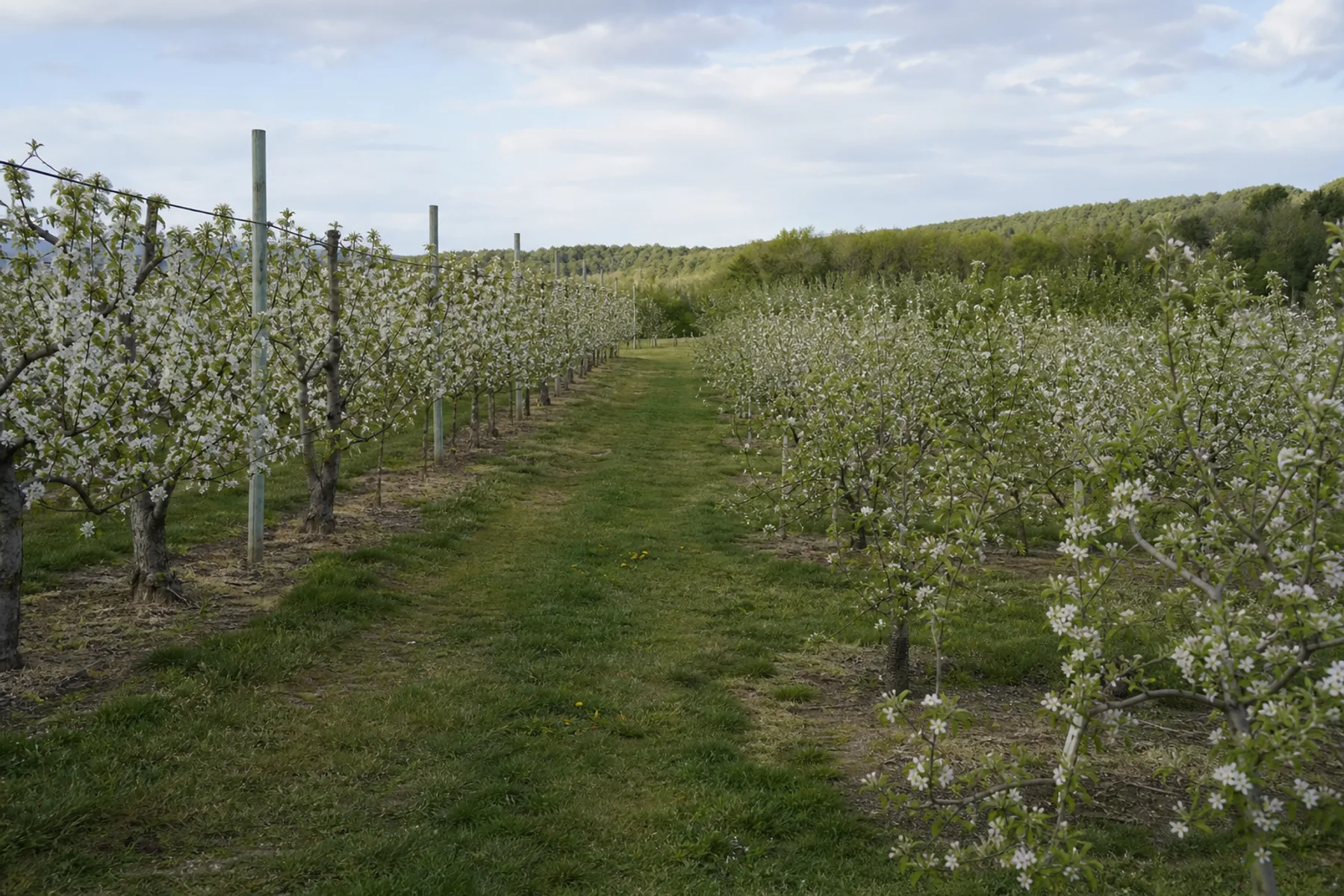
Small trees on semi-vigorous rootstocks planted densely in rows, cropping within about five years and harvested by machine — the system that made large-scale cider fruit supply possible and reshaped which cultivars are grown.
How long an orchard lives
A bush orchard is planned for about thirty years, a standard orchard for a working lifetime, and a perry pear orchard for a span measured in centuries — which changes what planting one means.
The traditional standard orchard
Large trees on vigorous rootstocks at wide spacing over permanent grassland: the orchard form that made cider country look the way it does, yields modestly, and lives long enough to become a habitat.
Grazed orchards and orchard agroforestry
Traditional orchards were always two enterprises on one hectare — fruit above, grass below — and that arrangement is now studied as silvopasture rather than assumed as farming practice.
Site and climate
Why an orchard is where it is, and what the ground and the weather decide before anything is planted.
A changing climate in the orchard
Warming springs are advancing bud burst and blossom faster than they are removing frost risk, shifting which varieties flower together and moving harvest earlier — changes that reach the vat as higher sugar and lower acid.
Frost pockets and orchard siting
Cold air is heavy and flows downhill, so the bottom of a valley is the coldest place in it on a still spring night — which is why orchards are planted on slopes and why a hedge across the fall of the land can ruin a site.
What a frost at blossom costs
A single night below freezing during flowering can remove an entire year’s crop, and for cider fruit the protective measures used in higher-value orchards rarely pay for themselves.
Why the cider regions are where they are
The great cider regions share a mild, wet, oceanic climate with cold enough winters and late enough springs — but climate only explains where cider could be made, not where it was.
Rainfall, and what a wet autumn does
Cider country is wet country, which suits the trees and complicates the harvest: a wet autumn dilutes juice, softens the ground under the machinery, and turns ground-lying fruit into a rot problem within days.
Soil and drainage in a cider orchard
Apple and pear roots need air as well as water, so drainage matters more than fertility; a deep, free-draining loam over a permeable subsoil will grow better fruit than a richer soil that lies wet in winter.
The trees
Rootstock, pollination and propagation — the decisions that are fixed for the life of the orchard.
Rootstocks and what they control
An apple tree is two plants grafted together, and the root half decides how big the tree gets, how soon it crops, how long it lives and how it copes with wet ground — not what the fruit tastes like.
Flowering overlap and planting a mixed orchard
Cider apples and perry pears are almost all self-incompatible, so a block that flowers alone crops badly. Apples use numbered pollination groups; perry pears use named bands, and the two schemes do not translate.
Pollination groups and flowering overlap
Apples are largely self-incompatible, so a tree needs pollen from a different, compatible cultivar in flower at the same time; the flowering-group numbers are a shorthand for whether two varieties will overlap.
Establishing a new cider orchard
The first three years decide the next thirty: weed-free ground around the trunk, protection from stock and wildlife, water in the first summer, and formative pruning that shapes a tree fit for how it will be harvested.
Grafting, scion wood and where a cider tree comes from
Every cider tree is a graft: a shoot of a named cultivar joined to a chosen rootstock. Where the scion wood came from determines the variety, its health status, and whether the tree is actually what the label says.
Triploids and why they cannot pollinate
A triploid apple carries three sets of chromosomes instead of two, produces almost no viable pollen, and therefore needs two other varieties in the orchard rather than one — a planting rule with no exceptions.
The growing year
What is actually done in an orchard, from bud burst to the last fruit off the ground.
How cider fruit develops and ripens
Fruit grows first by cell division and then by expansion, stores its summer photosynthate as starch, and converts that starch to sugar as it ripens — while acid falls and the phenolic content, laid down early, is progressively diluted.
Knowing when cider fruit is ready
Cider fruit is picked later than dessert fruit, because the maker wants maximum sugar rather than storage life; the starch–iodine test, the fruit’s own willingness to drop, and juice gravity are the practical checks.
The cider orchard year
What the trees are doing month by month, what the orchard needs at each stage, and where each stage shows up later in the juice.
Dormancy, winter chill and bud burst
Fruit trees need a measured quantity of winter cold before they will grow again, and only once that requirement is met does warmth drive them into bud burst and blossom.
June drop and fruit set
A tree sets far more fruitlets than it can carry and sheds the surplus in early summer; in a cider orchard, where thinning is almost never done, June drop is effectively the only crop regulation the trees get.
Windfalls and fruit on the ground
In cider, ground-lying fruit is not waste but the normal crop — which makes how long it lies, and in what condition, one of the more consequential decisions in the orchard.
Yield and what it pays
What an orchard produces, what it costs to get there, and how long it takes.
Biennial bearing and crop load
A heavy crop suppresses the flower buds that would have produced next year’s crop, so many cider cultivars settle into an on-year, off-year rhythm that whole districts fall into together.
Damaged fruit and what it costs
Bruised, rotten, frosted and over-ripe fruit each cost something different — juice, colour, microbial control, or in one specific case food safety — and the differences decide how much sorting is worth doing.
How long before a cider orchard pays
A bush orchard carries several years of cost before its first useful crop and longer before it recovers establishment; a standard orchard on fruit income alone frequently never does, which is why the reasons for planting one are usually not financial.
What a cider orchard yields
Yield per hectare differs by several times between orchard systems, swings between on-years and off-years, and translates into cider through a juice yield that itself depends on the fruit and the press.
Orchard health
Pests, diseases and disorders, the different tolerance a juice crop has for them, and how orchards are managed against them.
Apple scab, and mildew alongside it
Scab is the defining disease of wet cider country; its blemish does not matter for cider, but severe infection defoliates trees, cracks fruit and opens the way to rot — and powdery mildew, which prefers dry springs, works the opposite way round.
Brown rot, blue mould and why rotten fruit is a safety matter
Rotten fruit brings spoilage organisms into the vat and, in the case of blue mould, a regulated mycotoxin into the juice — which makes sorting before milling a food-safety control rather than a quality preference.
Canker in cider orchards
Canker is the disease that eventually kills apple trees in wet western orchards: a fungus that enters through leaf scars and wounds, girdles branches, and works inwards until the tree is a framework of dead limbs.
Fire blight, and why it dominates North American orchard thinking
A bacterial disease that enters through blossom and can kill a tree in a season, fire blight structures orchard decisions across much of North America while remaining a comparatively minor concern in English cider orchards.
Integrated management in a cider orchard
Monitoring, thresholds, cultural control and the deliberate conservation of natural enemies, with intervention as the last step rather than the first — an approach cider orchards suit unusually well because their tolerance for cosmetic damage is so high.
Organic and low-input cider orchards
Cider fruit is a better candidate for organic production than dessert fruit because blemish does not matter — but a wet western climate makes scab and canker hard to manage without synthetics, and low input means low nitrogen, which the cellar then has to deal with.
The pests that matter in a cider orchard
Because cosmetic damage does not disqualify cider fruit, the pests that matter are the ones that reduce the crop or open the way to rot — rosy apple aphid above all, with woolly aphid, blossom weevil, sawfly, codling moth and winter moth behind it.
Landscape and ecology
Traditional orchards as habitat, and what has happened to them.
Traditional orchards as a priority habitat
A traditional orchard is a designated UK Priority Habitat because it combines two scarce things in one place: veteran open-grown trees with decaying wood, and old undisturbed grassland beneath them.
The scale of orchard loss, and how it is known
England and Wales lost the majority of their traditional orchard area during the twentieth century; the Traditional Orchard Habitat Inventory turned that from an impression into mapped evidence, and it also recorded that much of what survives is in poor condition.
Veteran trees, deadwood and the species that need them
Decaying wood is the scarcest resource in the lowland landscape and the reason old orchards matter; the noble chafer, a beetle that develops in rotting heartwood, has one of its British strongholds in Three Counties orchards.
Mistletoe: parasite and priority species at once
Mistletoe takes water and minerals from the apple trees it grows on and will weaken a tree it dominates — and it is also a declining species whose British stronghold is precisely the traditional cider orchards of the Severn and Wye.
Everything else
Tree age and juice quality
Perry pear juice from young trees is measurably weaker than juice from old ones — less acid, less tannin, lower gravity — and the same effect operates, more quietly, in cider apples.
Restoring a neglected orchard
A neglected orchard is restored gradually — pruning over several seasons rather than one, filling gaps with the right cultivars, and re-establishing a grazing or cutting regime — while keeping the decaying wood that gives the place its value.
What grubbing up an orchard actually involves
Removing an orchard is a decision about a declining asset with no alternative buyer, taken against the cost of keeping it; understanding that arithmetic is more useful than deploring the outcome.
Described in full
- The scale
- A vertical scale in metres runs up the left, from ground level to ten metres. All three trees are drawn against it, and a marker one and seven-tenths metres high stands beside them as a human reference.
- Standard
- A large tree on a seedling, crab or M25 rootstock, reaching eight to ten metres with a clear trunk high enough for cattle to graze beneath. Roughly forty to a hundred trees per hectare, commonly living sixty to a hundred years and sometimes far longer.
- Half-standard
- Around five metres on M25 or MM111. Roughly a hundred to two hundred and fifty trees per hectare, productive for several decades. The usual choice where a grower wants a manageable tree that still permits grazing.
- Bush
- Under three metres on MM106 or MM111, planted in dense rows for machine harvesting. Roughly four hundred to twelve hundred trees per hectare, commonly replaced after twenty-five to thirty-five years.
- Why the drawing is at true relative scale
- The height difference is the point. A standard is not a large bush; it is a different kind of object, and the practices that follow — how it is pruned, harvested and grazed under — follow from its size.
- What density means for yield
- A bush orchard produces several times as much fruit per hectare as a standard. That is the trade, and it is a real one rather than a decline narrative.
- What density means for habitat
- An eighty-year-old standard orchard carries decaying wood, hollowing trunks and an unploughed sward that took decades to form. A bush orchard is a crop planting with a replacement date. Both statements are true at once.
Next
- Cider apples — the cultivars themselves, with vigour, pollination group and biennial habit on each record.
- How cider is made — the orchard and harvest stages of the sequence, method by method.
- Regions — why cider country is where it is, and what each tradition grows.