Measuring guide
What to measure, and what each number tells you
What should I be measuring, and what do the numbers mean?
In short
Five numbers cover almost everything a maker needs: specific gravity, temperature, pH, titratable acidity and free sulphur dioxide. The first two are cheap and answer most questions. The third and fourth are separate questions that sound like one. The fifth only means anything alongside the third.
The single most valuable habit is recording a series rather than a reading. One gravity figure tells you almost nothing; three over a week tell you whether the ferment is running, slowing or stopped, which is the question you actually have.
Every measurement here has a characteristic failure mode, and in each case the wrong reading looks entirely normal. That is why the failure modes are given as much space as the methods.
Who this is for. Anyone using the calculators on this site and wondering where the inputs come from, or making cider and unsure which instruments are worth owning. (no experience assumed · 6 steps)
A hydrometer and a thermometer are enough to make cider deliberately. pH and acidity become worth measuring once you are blending or deciding about sulphite. Dissolved oxygen and laboratory nitrogen analysis belong to commercial scale, and the guide says where each line falls.
Described in full
- Layout
- Five rows, one per measurement, each split into what it detects and what it cannot. The second half of each row is the substance: a measurement misused is worse than one not taken, because the number looks the same either way.
- Specific gravity
- Tells you dissolved solids, and so sugar in a juice and alcohol when read against a starting figure. It does not tell you whether a fermentation has finished — that needs two readings days apart — and in a perry it includes sorbitol, which never ferments.
- Refractometer
- Tells you sugar concentration in unfermented juice from two drops. It does not work once fermentation has begun: ethanol bends light differently, so a fermenting sample reads as though it holds far more sugar than it does. This is the commonest instrument error in home cider-making.
- Titratable acidity
- Tells you how much acid is present, and so how sharp the cider will read. It does not tell you pH, and the two can move apart — a malolactic fermentation lowers acidity a little and raises pH considerably more.
- pH
- Tells you microbial risk and how much of any free sulphur dioxide is in its active molecular form. It does not tell you how sharp the cider tastes, and an uncalibrated meter gives a plausible wrong answer rather than an obviously wrong one.
- Free sulphur dioxide
- Tells you almost nothing on its own. Only alongside pH does it become molecular SO₂, which is the figure that has an antimicrobial meaning. The same free reading protects a sharp juice and leaves a low-acid bittersweet one effectively unprotected.
The path
Each step says what happens, why it matters downstream, and what you are actually deciding. The links under a step are where the depth is.
1. Specific gravity: the workhorse, and its two traps
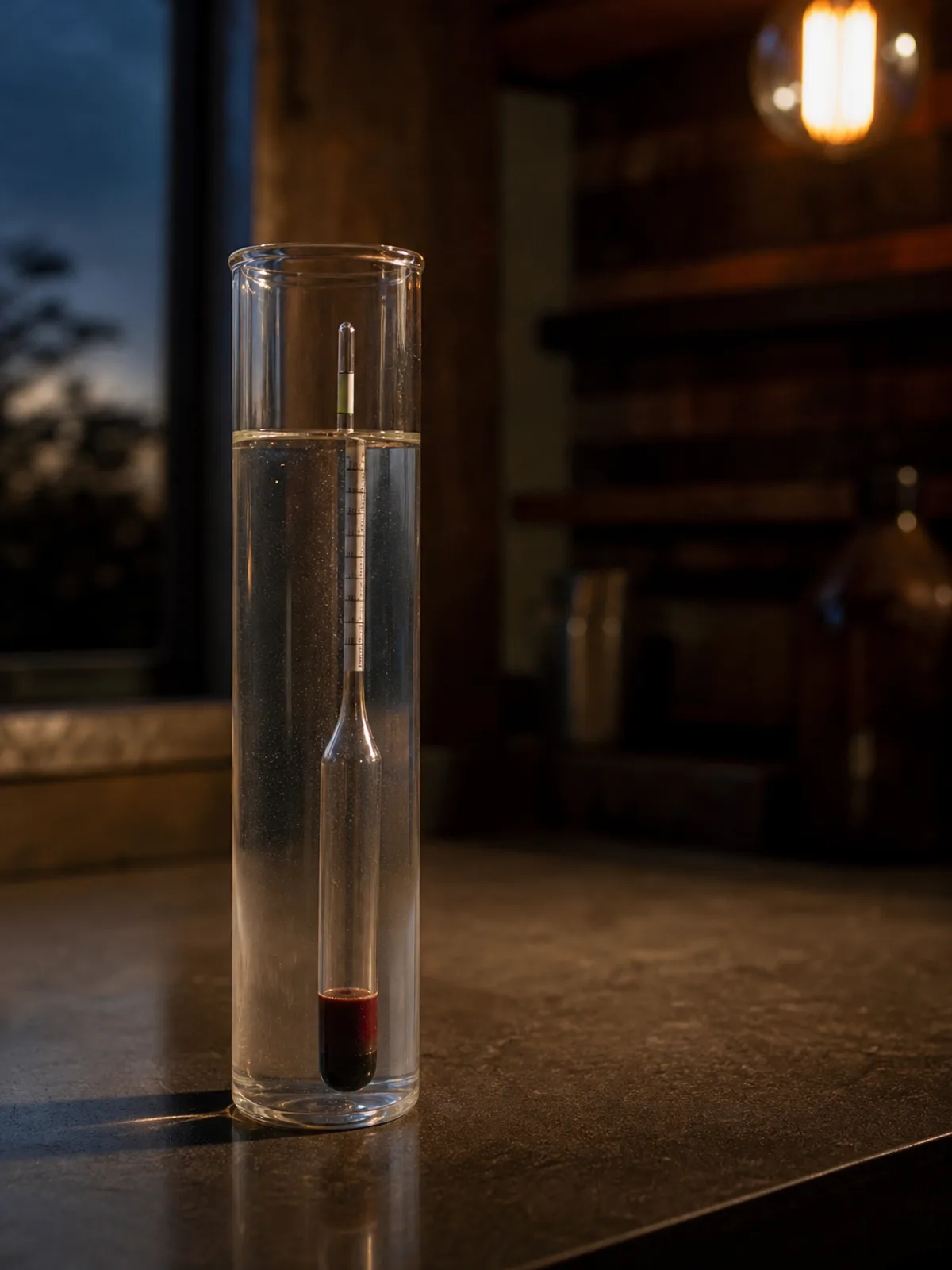
A hydrometer floats higher in a denser liquid, and dissolved sugar makes juice denser than water. Reading where the surface cuts the stem gives specific gravity, from which sugar and so potential alcohol follow. Take one reading before fermentation and one at the end, and the difference gives the alcohol.
The two traps are temperature and carbon dioxide. Hydrometers are calibrated at a stated temperature, usually 20 °C, and a reading taken on cold juice or on a warm active ferment is wrong by an amount worth correcting. Dissolved carbon dioxide in a fermenting sample makes the liquid buoyant and the reading low; degassing the sample first is the fix.
There is a third trap that is not about the instrument. A reading on its own answers almost nothing — 1.054 is a number, not a finding — and the question a maker actually has is whether it is ordinary for what they pressed. That requires something to sit it against, and most published ranges are quoted without saying whose fruit, which years or which laboratory produced them. Compare against measurements that carry their context, or treat the figure as a baseline for your own second reading rather than as a verdict.
Why it matters: This is the only measurement from which alcohol can be calculated at all, and the starting reading is not recoverable once fermentation has begun.
What you are deciding
- Whether to correct for temperature. Below about three degrees off calibration it hardly matters; at fifteen degrees off it matters a great deal.
- Whether to trust a single reading. Two identical readings days apart is the only evidence that a ferment has stopped.
What to measure
- Specific gravity, temperature-corrected — Dissolved solids. In a juice that is mostly sugar; in a finished cider it includes glycerol, acids and — in perry — sorbitol, which is why a dry perry does not read 1.000. Work it out.
- The correction, where the sample was not at the hydrometer’s calibration temperature — What the reading should have been. At fifteen degrees off calibration the error is around five points, which is larger than the change two readings days apart are meant to detect. Work it out.
- Starting and finishing gravity together — Alcohol by volume. Two formulas are in general use and they diverge above about 1.070; a calculator that shows only one is hiding the disagreement. Work it out.
- Apparent attenuation — What proportion of the available sugar has gone. A dry cider can read above 100% on this scale; a perry reads low without having stalled. Work it out.
What can go wrong here
Tools for this step
Go deeper
- Juice analysis interpreter — Where a reading sits against measurements recorded with their orchard, period and source — and which readings this site refuses to place.
- The hydrometer and the trial jar — The instrument, how to read it, and how to look after it.
- Gravity measurement — Taking the reading as a procedure rather than as a glance.
- Drawing a sample without spoiling the batch — Getting a sample that represents the vessel, which most readings assume.
- Sorbitol — Why a perry’s finishing gravity is not a cider’s finishing gravity.
Sources for this step
The New Cider Maker’s Handbook: A Comprehensive Guide for Craft Producers
Claude Jolicoeur, Chelsea Green Publishing, 2013. ISBN 9781603584739 · reference work · bibliographic record verified, not opened 2026-08-25
Bibliographic record verified on 2026-08-25 against the Open Library union catalogue: Chelsea Green Publishing, 2013, ISBN 9781603584739, one edition recorded. That establishes the citation points at a real book in a stated edition, which is what a citation needs and is all it establishes. No copy was opened and nothing is quoted from it. The book itself is in print and not digitised in any open collection; where CiderHQ needs a figure from this territory it uses an accessible research source instead and says so.
Research on pear juice composition and sorbitol in perry
Various journals and institute reports · peer-reviewed literature · registered as competent for this subject
The evidence base for the single most important chemical difference between cider and perry: pears carry substantial sorbitol, which yeast does not ferment, so a fully fermented perry retains sweetness a fully fermented cider cannot.
2. Refractometers: excellent before fermentation, misleading after it
A refractometer measures how much a drop of liquid bends light, which for a sugar solution maps cleanly onto concentration in degrees Brix. It needs two drops rather than a jarful, which makes it the practical instrument for checking fruit in the orchard or juice as it runs from the press.
The moment fermentation starts it becomes unreliable, and not by a small margin. Ethanol has a different refractive index from water, so a fermenting sample reads as though it contains far more sugar than it does. Correction formulas exist and are approximations. For monitoring a ferment, use a hydrometer.
Why it matters: This is the commonest instrument error in home cider-making, and it produces readings that appear to show a stuck fermentation in a batch that is fermenting perfectly well.
What you are deciding
- Which instrument for which question. Refractometer before the yeast goes in; hydrometer afterwards.
What to measure
- Degrees Brix on unfermented juice — Sugar concentration, and so — converted — the specific gravity and the potential alcohol. Work it out.
Tools for this step
Go deeper
- The refractometer, and why it lies during fermentation — The instrument and its limits, in more detail.
- Laboratory measurement versus practical measurement — Which instruments earn their place at which scale.
Sources for this step
The New Cider Maker’s Handbook: A Comprehensive Guide for Craft Producers
Claude Jolicoeur, Chelsea Green Publishing, 2013. ISBN 9781603584739 · reference work · bibliographic record verified, not opened 2026-08-25
Bibliographic record verified on 2026-08-25 against the Open Library union catalogue: Chelsea Green Publishing, 2013, ISBN 9781603584739, one edition recorded. That establishes the citation points at a real book in a stated edition, which is what a citation needs and is all it establishes. No copy was opened and nothing is quoted from it. The book itself is in print and not digitised in any open collection; where CiderHQ needs a figure from this territory it uses an accessible research source instead and says so.
Cornell Cider Research and Extension programme
Cornell University, School of Integrative Plant Science · university · passage verified 2026-08-24
Runs cultivar trials in New York State and publishes juice chemistry for European cider varieties grown in a North American climate — the single most useful counterweight to treating English figures as universal.
3. pH and titratable acidity are two different measurements
Titratable acidity counts how much acid is present, by neutralising it with a known alkali and measuring how much it took. It is the number that corresponds to how sharp the cider tastes. pH measures how strongly that acid is dissociated in the solution, which is what governs microbial behaviour and the effectiveness of sulphite.
They move together loosely and they can move apart. A cider that has been through malolactic fermentation has had its malic acid replaced by the weaker lactic acid: titratable acidity falls a little, pH rises more, and the microbial security falls further than the taste suggests. Measuring one and inferring the other is how a cider ends up unprotected.
Neither of them settles how sharp the cider will taste, which is the thing most people are trying to find out. Sweetness masks acid, tannin reads as dryness, carbonation adds a perceived sharpness of its own, and temperature moves all three — so two ciders at the same titratable acidity can be a long way apart in the glass. The measurement narrows the question and the bench trial answers it; a maker who adjusts acid from the number alone is correcting something they have not yet tasted.
Why it matters: Almost every sulphite decision depends on pH, and almost every blending decision depends on titratable acidity. Substituting one for the other gets both wrong.
What you are deciding
- Which question you are asking. "Does it taste sharp enough" is titratable acidity; "is it safe from spoilage and will my sulphite work" is pH.
- Whether to buy a meter or use indicator strips. Strips are adequate for a rough check and not adequate for a sulphite decision.
What to measure
- Titratable acidity, from a titration — How much acid there is — in all three conventions at once, because the same cider is reported as malic, sulphuric or tartaric acid depending on who is asking, and the three differ by up to a third. Work it out.
- pH, on a calibrated meter — Microbial risk and sulphite efficacy. An uncalibrated meter drifts and gives a plausible wrong answer. Work it out.
What can go wrong here
Tools for this step
Go deeper
- Titratable acidity — Turning a burette reading into a figure, in each of the three conventions.
- pH versus titratable acidity — The distinction in full, with why the two diverge.
- Titration kits for total acidity — Running the titration, including where the endpoint actually is.
- The pH meter and its calibration — The instrument, and the calibration it needs to mean anything.
- The acids in cider — Which acids are present and what each contributes.
Sources for this step
The Science of Cidermaking and associated technical writing
Andrew Lea · reference work · passage verified 2026-08-24
Written by a food chemist who worked at Long Ashton on apple phenolics. Unusual among specialist cider writing in that it is primary-research-adjacent: the author is describing work he did, and cites the literature. This is why it is registered at tier 1 for chemistry while a general cider book is not.
Cider and perry production technical training material
Peter Mitchell / Cider and Perry Academy · reference work · registered as competent for this subject
Searched again on 2026-08-25 and it remains the one printed source here that a bibliographic check cannot fix, because it is not a published work with an edition. It is course material issued to participants of a training programme, so there is no catalogue record to verify, no ISBN, and no lawful public copy. Its state stays `registered` for that reason rather than through inattention.
The New Cider Maker’s Handbook: A Comprehensive Guide for Craft Producers
Claude Jolicoeur, Chelsea Green Publishing, 2013. ISBN 9781603584739 · reference work · bibliographic record verified, not opened 2026-08-25
Bibliographic record verified on 2026-08-25 against the Open Library union catalogue: Chelsea Green Publishing, 2013, ISBN 9781603584739, one edition recorded. That establishes the citation points at a real book in a stated edition, which is what a citation needs and is all it establishes. No copy was opened and nothing is quoted from it. The book itself is in print and not digitised in any open collection; where CiderHQ needs a figure from this territory it uses an accessible research source instead and says so.
4. Free SO₂ means nothing without the pH beside it
Sulphur dioxide in solution exists in three forms, and only the molecular form has significant antimicrobial effect. The proportion in that form is set by pH, and it falls steeply as pH rises. At pH 3.2 a given free SO₂ figure delivers several times the molecular concentration it delivers at pH 3.8.
This is why a single recommended addition figure is not a useful thing to publish. The same addition protects a sharp juice and leaves a low-acid bittersweet juice effectively unprotected, and the maker who followed the figure has no way of knowing which happened.
Why it matters: It explains why low-acid, high-tannin fruit is genuinely difficult to protect, and why blending in sharp fruit is a microbiological decision as much as a sensory one.
Take care hereSulphite levels are governed by food law, and sulphur dioxide above the labelling threshold must be declared as an allergen on anything sold. Some people react to sulphites at ordinary levels. CiderHQ publishes the pH relationship and not a dose: take the figure from your supplier or your regulator.
What you are deciding
- Whether to lower pH before sulphiting rather than raising the sulphite. Below roughly pH 3.5 the chemistry starts working for you.
- Whether the cider can carry the sulphite at all: excess is detectable as a struck-match or burnt-match character and is itself a fault.
What to measure
- Free SO₂, and pH at the same time — Together, the molecular SO₂ — which is the figure that means something. Either alone means very little. Work it out.
What can go wrong here
Tools for this step
Go deeper
- Sulphur dioxide, and why pH governs it — The relationship, with the chemistry behind the curve.
- Sulphur dioxide — What it does to which organisms, and what it binds to.
- Measuring sulphur dioxide — How free and total SO₂ are actually measured.
- Excess sulphur dioxide — What too much smells like, and whether it goes away.
Sources for this step
The Science of Cidermaking and associated technical writing
Andrew Lea · reference work · passage verified 2026-08-24
Written by a food chemist who worked at Long Ashton on apple phenolics. Unusual among specialist cider writing in that it is primary-research-adjacent: the author is describing work he did, and cites the literature. This is why it is registered at tier 1 for chemistry while a general cider book is not.
European Food Safety Authority scientific opinions
EFSA · regulator · retrieved 2026-08-24
Registered for the food-safety questions cider genuinely raises: patulin in juice from rotten fruit, sulphite sensitivity, and the toxicology behind additive limits.
Food labelling and packaging guidance
Food Standards Agency / Department for Business and Trade · regulator · retrieved 2026-08-24
5. Temperature: measure the liquid, not the room
An active fermentation is exothermic. In anything larger than a demijohn the liquid runs warmer than the air around it, and in a full-sized vessel the difference can be several degrees. A thermometer on the wall is measuring the wrong thing.
Temperature also enters almost every other measurement. Hydrometers are calibrated to a temperature, pH readings are temperature-dependent, and the pressure a carbonated bottle reaches depends on the temperature it reaches — which is the warmest it will ever see, not the temperature of the cellar it normally sits in.
Why it matters: Temperature is both a control variable and a correction term in everything else, and it is the measurement most often taken from the wrong place.
Take care hereThe temperature that governs bottle pressure is the warmest the bottles will ever reach, not the temperature of the place they normally sit. A batch primed against a 10 °C cellar and then left in a room that reaches 25 °C is at a substantially higher pressure than the calculation assumed, and over-pressurised glass fails by fragmenting. Take the figure from the worst case rather than the usual one.
What to measure
- Liquid temperature at the centre of the vessel — What the yeast is actually experiencing. Surface and ambient readings both understate it during active fermentation.
- Warmest storage temperature the bottles will see — The pressure the carbonation will reach. This is the figure the bottle has to survive. Work it out.
What can go wrong here
Tools for this step
Go deeper
- Thermometers and temperature measurement — Which instrument, and where to put it.
- Fermentation temperature control — What temperature does to aroma as well as to rate.
- How temperature changes taste — The serving side of the same variable.
Sources for this step
The New Cider Maker’s Handbook: A Comprehensive Guide for Craft Producers
Claude Jolicoeur, Chelsea Green Publishing, 2013. ISBN 9781603584739 · reference work · bibliographic record verified, not opened 2026-08-25
Bibliographic record verified on 2026-08-25 against the Open Library union catalogue: Chelsea Green Publishing, 2013, ISBN 9781603584739, one edition recorded. That establishes the citation points at a real book in a stated edition, which is what a citation needs and is all it establishes. No copy was opened and nothing is quoted from it. The book itself is in print and not digitised in any open collection; where CiderHQ needs a figure from this territory it uses an accessible research source instead and says so.
Cider and perry production technical training material
Peter Mitchell / Cider and Perry Academy · reference work · registered as competent for this subject
Searched again on 2026-08-25 and it remains the one printed source here that a bibliographic check cannot fix, because it is not a published work with an edition. It is course material issued to participants of a training programme, so there is no catalogue record to verify, no ISBN, and no lawful public copy. Its state stays `registered` for that reason rather than through inattention.
6. What an instrument is worth, and when
A hydrometer and a thermometer make cider deliberate rather than hopeful, and together cost less than a case of bottles. Everything above that is bought against a specific question. A pH meter earns its place when you start making sulphite decisions or blending seriously. Acid titration equipment earns its place at the same point.
Beyond that the return falls off sharply for a home maker. Dissolved oxygen meters, laboratory nitrogen analysis and sulphur dioxide titration apparatus are commercial instruments answering commercial questions, and a small maker is generally better served by buying an occasional analysis than by buying the instrument.
Why it matters: The commonest equipment mistake is not owning too little; it is owning instruments that are never calibrated, which produce confident wrong numbers.
What you are deciding
- Buy the instrument or buy the analysis. For anything measured once or twice a year, the analysis usually wins.
- Calibration schedule. An uncalibrated pH meter is worse than no pH meter, because it is believed.
Go deeper
- Laboratory measurement versus practical measurement — Where the line falls between the two, at each scale.
- Calibration: instruments as things that need maintaining — What has to be checked and how often.
- Kitchen and garage scale: what the setup actually is — What the smallest scale actually needs.
- Farm mill and commercial plant: what changes with scale — Where the requirements change and why.
Sources for this step
Cider and perry production technical training material
Peter Mitchell / Cider and Perry Academy · reference work · registered as competent for this subject
Searched again on 2026-08-25 and it remains the one printed source here that a bibliographic check cannot fix, because it is not a published work with an edition. It is course material issued to participants of a training programme, so there is no catalogue record to verify, no ISBN, and no lawful public copy. Its state stays `registered` for that reason rather than through inattention.
The New Cider Maker’s Handbook: A Comprehensive Guide for Craft Producers
Claude Jolicoeur, Chelsea Green Publishing, 2013. ISBN 9781603584739 · reference work · bibliographic record verified, not opened 2026-08-25
Bibliographic record verified on 2026-08-25 against the Open Library union catalogue: Chelsea Green Publishing, 2013, ISBN 9781603584739, one edition recorded. That establishes the citation points at a real book in a stated edition, which is what a citation needs and is all it establishes. No copy was opened and nothing is quoted from it. The book itself is in print and not digitised in any open collection; where CiderHQ needs a figure from this territory it uses an accessible research source instead and says so.
Where to go next
Guides that follow on from this one.
Questions this answers
Shown so you can tell whether this is the guide you wanted.
- What should I measure when making cider?
- How do I use a hydrometer?
- Why is my refractometer reading wrong during fermentation?
- What is the difference between pH and acidity?
- How much sulphite should I add?
- How do I know when fermentation has finished?
Where to go next
- All guides — The other paths, grouped by what you are trying to do.
- Tools and calculators — The arithmetic each step refers to, with the formula shown.
- Troubleshooting — The fault records behind every "watch for" above.
Sources
What this page rests on. Where a source is marked as registered rather than read, CiderHQ is recording that the body is authoritative on the subject without claiming to have worked through the document itself. See our evidence policy for what each state means.
The New Cider Maker’s Handbook: A Comprehensive Guide for Craft Producers
Claude Jolicoeur, Chelsea Green Publishing, 2013. ISBN 9781603584739 · reference work · bibliographic record verified, not opened 2026-08-25
Bibliographic record verified on 2026-08-25 against the Open Library union catalogue: Chelsea Green Publishing, 2013, ISBN 9781603584739, one edition recorded. That establishes the citation points at a real book in a stated edition, which is what a citation needs and is all it establishes. No copy was opened and nothing is quoted from it. The book itself is in print and not digitised in any open collection; where CiderHQ needs a figure from this territory it uses an accessible research source instead and says so.
Cider and perry production technical training material
Peter Mitchell / Cider and Perry Academy · reference work · registered as competent for this subject
Searched again on 2026-08-25 and it remains the one printed source here that a bibliographic check cannot fix, because it is not a published work with an edition. It is course material issued to participants of a training programme, so there is no catalogue record to verify, no ISBN, and no lawful public copy. Its state stays `registered` for that reason rather than through inattention.
The Science of Cidermaking and associated technical writing
Andrew Lea · reference work · passage verified 2026-08-24
Written by a food chemist who worked at Long Ashton on apple phenolics. Unusual among specialist cider writing in that it is primary-research-adjacent: the author is describing work he did, and cites the literature. This is why it is registered at tier 1 for chemistry while a general cider book is not.
Cornell Cider Research and Extension programme
Cornell University, School of Integrative Plant Science · university · passage verified 2026-08-24
Runs cultivar trials in New York State and publishes juice chemistry for European cider varieties grown in a North American climate — the single most useful counterweight to treating English figures as universal.