Making guide
Your first batch of cider
I have apples and no equipment. What do I actually do?
In short
Get the juice — press it or buy it unpasteurised and unpreserved — put it in a vessel with an airlock, add a yeast, and leave it somewhere cool for a fortnight. Then rack it off the sediment into a full vessel and wait two more months before you taste it seriously.
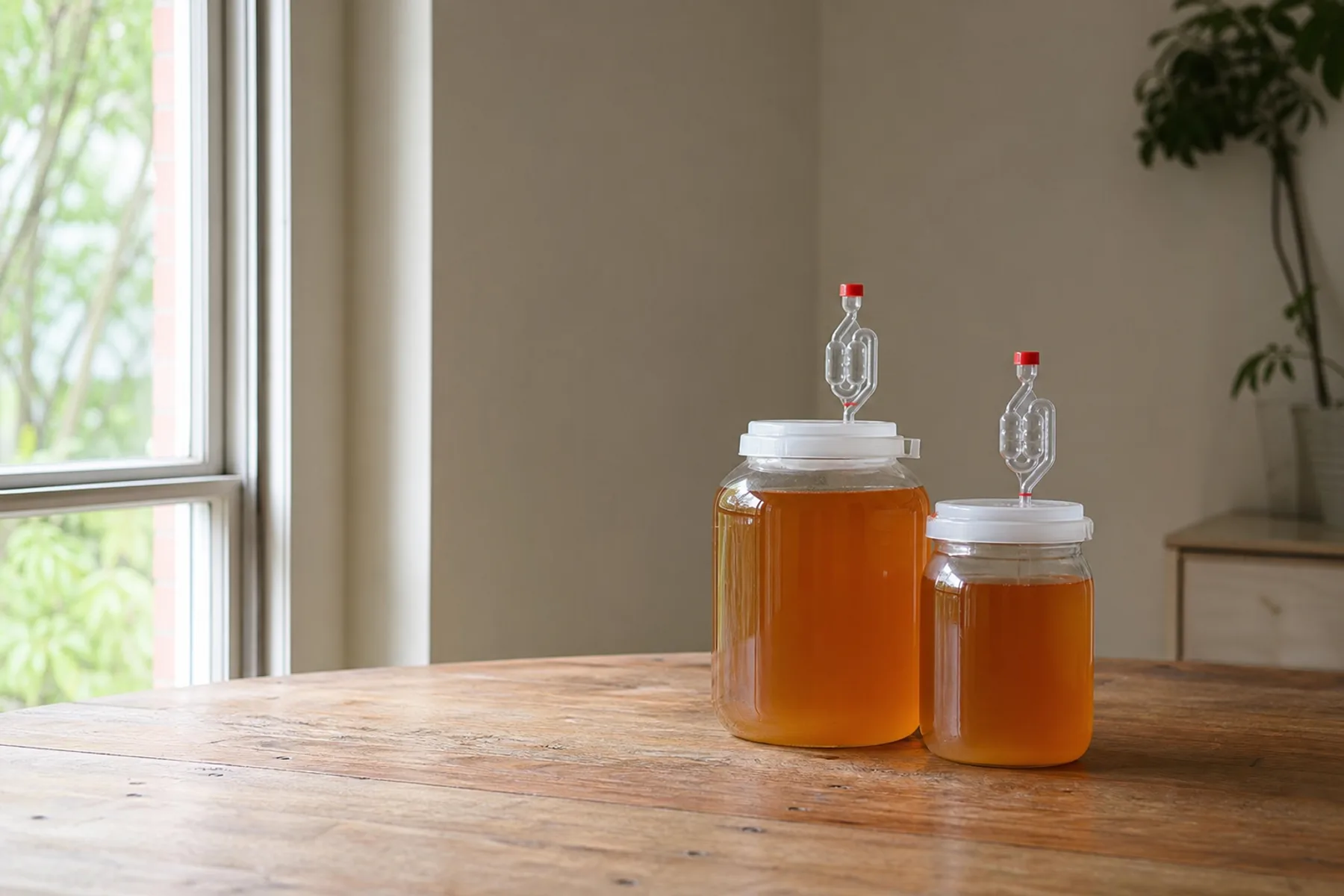
The equipment that genuinely matters is a fermenting vessel that seals, an airlock, a length of tubing for racking, and a hydrometer. The hydrometer is the one people skip and the one that turns the exercise from a hope into a measurement.
The commonest first-batch failures are all avoidable and none of them are exotic: too warm, too much headspace, bottled too early, and bottled into the wrong glass.
Who this is for. Somebody making cider for the first time who wants a single defensible path rather than a survey of options. Where a real choice exists, this guide picks one and says why, and points at the alternatives rather than presenting them. (no experience assumed · 8 steps)
- How cider is made, start to finish — How is cider actually made?
Written for five to twenty-five litres. Below five litres the surface-to-volume ratio makes oxidation and temperature swings disproportionately damaging; above about fifty the vessels stop being liftable and the assumptions about equipment change.
The path
Each step says what happens, why it matters downstream, and what you are actually deciding. The links under a step are where the depth is.
1. Get juice, one of two ways
Pressing your own is better and harder. If you have fruit and access to a press — many orchards and community groups run one in the autumn — mill and press as described in the main pathway, and use the juice the same day.
Buying juice is entirely legitimate and removes the largest single source of first-batch failure. What you need is unpasteurised or pasteurised apple juice with nothing added: specifically no potassium sorbate, no benzoate, and no ascorbic acid beyond a trace. Preservatives are there to stop exactly the fermentation you are trying to start, and a juice carrying sorbate will not ferment, or will ferment badly and smell of geraniums.
Why it matters: Everything downstream assumes fermentable juice with a live-microbiology history you know something about. A preserved juice fails at the first step and the failure is not obvious for several days.
What you are deciding
- Press or buy. Buying is not cheating and produces a better first result more reliably.
- If buying: read the ingredients list, not the front label. "No added sugar" is not the claim you need.
What to measure
- Starting specific gravity — The sugar you are starting with, and so the strength you will finish at. Without this reading the final ABV cannot be calculated at all — it is not recoverable later. Work it out.
What can go wrong here
Tools for this step
Go deeper
- The hydrometer and the trial jar — How to use one and what the reading is actually measuring.
- Potassium sorbate — Why a preserved juice will not ferment, and what it smells like when it half does.
- Gravity measurement — Taking the reading properly, including the temperature correction most people skip.
Sources for this step
The New Cider Maker’s Handbook: A Comprehensive Guide for Craft Producers
Claude Jolicoeur, Chelsea Green Publishing, 2013. ISBN 9781603584739 · reference work · bibliographic record verified, not opened 2026-08-25
Bibliographic record verified on 2026-08-25 against the Open Library union catalogue: Chelsea Green Publishing, 2013, ISBN 9781603584739, one edition recorded. That establishes the citation points at a real book in a stated edition, which is what a citation needs and is all it establishes. No copy was opened and nothing is quoted from it. The book itself is in print and not digitised in any open collection; where CiderHQ needs a figure from this territory it uses an accessible research source instead and says so.
2. A vessel that seals, and nothing more elaborate
A glass demijohn or a food-grade plastic fermenter with a drilled lid, plus an airlock. The airlock lets carbon dioxide out and keeps air and insects from getting in, which is the whole requirement. An open vessel covered with a cloth also works for the first violent days and is how a great deal of traditional cider was made, but it gives acetic bacteria and vinegar flies an opening that a sealed vessel does not.
Clean is not the same as sanitised. Everything the juice touches after pressing should be sanitised — a proprietary no-rinse sanitiser is the practical answer — because the fermentation you want has to out-compete every organism you introduced by accident.
Why it matters: Sanitation failures do not announce themselves. They present three weeks later as a smell nobody can place, and by then the batch is what it is.
Take care hereNever seal a fermenting vessel without an airlock or other gas escape. An active ferment generates carbon dioxide continuously and a sealed rigid container will either fail at its weakest point or burst.
What you are deciding
- Glass or plastic. Glass is inert and heavy and breaks; plastic scratches, and scratches harbour organisms.
- How much headspace to leave. A vigorous ferment needs room or it will push through the airlock; a finished one needs almost none.
What can go wrong here
Go deeper
- Choosing a fermentation vessel: material and shape — What each vessel type is actually good at.
- Sanitation — What sanitising does, what it does not do, and where it matters most.
- Sanitation: clean, sanitised, and why it decides the batch — The practical version, at the scale of one vessel.
Sources for this step
The New Cider Maker’s Handbook: A Comprehensive Guide for Craft Producers
Claude Jolicoeur, Chelsea Green Publishing, 2013. ISBN 9781603584739 · reference work · bibliographic record verified, not opened 2026-08-25
Bibliographic record verified on 2026-08-25 against the Open Library union catalogue: Chelsea Green Publishing, 2013, ISBN 9781603584739, one edition recorded. That establishes the citation points at a real book in a stated edition, which is what a citation needs and is all it establishes. No copy was opened and nothing is quoted from it. The book itself is in print and not digitised in any open collection; where CiderHQ needs a figure from this territory it uses an accessible research source instead and says so.
Cider: Making, Using and Enjoying Sweet and Hard Cider
Annie Proulx and Lew Nichols, Storey Communications, 1997; first published as Sweet & Hard Cider by Garden Way, 1980 · reference work · bibliographic record verified, not opened 2026-08-25
Bibliographic record verified on 2026-08-25 against Open Library, and the verification changed what CiderHQ knows about it. The work first appeared in 1980 as Sweet & Hard Cider: Making It, Using It, & Enjoying It (Garden Way, Charlotte, Vermont) and was retitled for the 1997 Storey edition the site had registered; nine editions are recorded in total. That matters for a source cited on North American practice, because a passage in the 1980 text and a passage in the 1997 one are not interchangeable and neither is the 2003 revision. Two scans exist in the Internet Archive — sweethardciderma0000prou for the 1980 edition and cidermakingusing0000prou for the 1997 — both access-restricted to the lending library and the print-disabled collection, so neither is openable by retrieval.
3. Pitch a yeast, for the first batch at least
A wild fermentation is a real thing and is how the styles this site describes at length were made. It is also unpredictable, and an unpredictable first batch teaches you very little because you cannot tell which of your decisions produced the result.
A dried wine or cider yeast rehydrated according to its packet is the controlled option. It will out-compete most of what is on the fruit, it will finish, and it will do so without producing the volatile-acidity or mousiness that a badly-behaved wild population can.
Why it matters: The first batch is an experiment with one variable you control. Making the organism another unknown removes most of what you could learn.
What you are deciding
- Which yeast. A neutral wine yeast gives you the fruit; a cider-specific strain gives you more character and more variables.
- Whether to add nutrient. Apple juice is frequently short of assimilable nitrogen, and shortage causes both stalled ferments and a rotten-egg smell that is unpleasant and, if left, becomes permanent.
What can go wrong here
Go deeper
- Yeast rehydration — The step that is skipped most and matters more than it looks.
- Yeast selection — What a strain choice actually changes.
- Wild vs cultured fermentation — The honest comparison, for when you want to try the other route.
- The nitrogen problem in cider juice — Why so many apple juices are short, and what shortage produces.
Sources for this step
Cornell Cider Research and Extension programme
Cornell University, School of Integrative Plant Science · university · passage verified 2026-08-24
Runs cultivar trials in New York State and publishes juice chemistry for European cider varieties grown in a North American climate — the single most useful counterweight to treating English figures as universal.
Boudreau, Peck, O’Keefe and Stewart, Food Science & Nutrition 6(1):119–123 · peer-reviewed literature · passage verified 2026-08-24 · covers 2014–2015
Open access; read in full on 2026-08-24. The paper that gives cider its own nitrogen numbers instead of borrowing wine’s. A hundred and eight apple samples from Virginia over two seasons, with the two fractions of assimilable nitrogen measured separately — which matters, because the finding is that apple juice is short of ammonium specifically, and that the wine practice of measuring both fractions may be unnecessary for apples while the wine practice of assuming there is enough nitrogen is badly wrong.
Song, Gibney, Cheng, Liu and Peck, Frontiers in Microbiology 11:1264 · peer-reviewed literature · passage verified 2026-08-24 · covers 2016
Open access; read in full on 2026-08-24. This is the paper CiderHQ cites against the folk rule that low nitrogen causes sulphide and adding nutrient cures it. Two Saccharomyces strains fermented the same Cornell juice at three nitrogen levels: one strain produced no detectable hydrogen sulphide at any level, and in the strain that did, the middle nitrogen treatment produced the most — twice the low treatment and six times the high. A rule that is true on average is being applied to individual batches where it can be exactly backwards, and the correction is worth a page of its own.
4. Cool, dark, and left alone
Somewhere between about 12 and 18 °C, stable, out of sunlight. Airlock activity starts within a day or two and becomes vigorous within three. It will slow after a week or so and the surface foam will fall back.
Take a gravity reading at the start and then every few days once the visible activity slows. What you are looking for is two identical readings several days apart, which is the only reliable signal that fermentation has stopped. Bubble counting is not a measurement — an airlock bubbles from temperature change alone.
Why it matters: Bottling a cider that has not finished is the mechanism behind every burst bottle in a first batch, and the gravity reading is the only thing that distinguishes finished from paused.
What you are deciding
- Where to put it. Stability beats coldness: a cupboard that stays at 16 °C is better than a shed that swings between 4 and 20.
What to measure
- Specific gravity, twice, several days apart — Whether it has finished. Identical readings mean stopped; a gravity still above about 1.005 that has stopped means stuck rather than finished. Work it out.
- Starting and finishing gravity together — The alcohol by volume. Two formulas are in common use and they diverge at high gravity; the tool shows both rather than picking one silently. Work it out.
What can go wrong here
Tools for this step
Go deeper
- Fermentation temperature control — What temperature does to the aroma, not just to the rate.
- Fermentation monitoring — What to write down, and why the series matters more than any reading.
- Stuck fermentation — What to do if the gravity stops well above dry.
- Fermentation progress — Your readings so far, read as a curve rather than one number at a time.
Sources for this step
The New Cider Maker’s Handbook: A Comprehensive Guide for Craft Producers
Claude Jolicoeur, Chelsea Green Publishing, 2013. ISBN 9781603584739 · reference work · bibliographic record verified, not opened 2026-08-25
Bibliographic record verified on 2026-08-25 against the Open Library union catalogue: Chelsea Green Publishing, 2013, ISBN 9781603584739, one edition recorded. That establishes the citation points at a real book in a stated edition, which is what a citation needs and is all it establishes. No copy was opened and nothing is quoted from it. The book itself is in print and not digitised in any open collection; where CiderHQ needs a figure from this territory it uses an accessible research source instead and says so.
The Science of Cidermaking and associated technical writing
Andrew Lea · reference work · passage verified 2026-08-24
Written by a food chemist who worked at Long Ashton on apple phenolics. Unusual among specialist cider writing in that it is primary-research-adjacent: the author is describing work he did, and cites the literature. This is why it is registered at tier 1 for chemistry while a general cider book is not.
5. Rack it off the sediment, and fill the vessel
Siphon the cider off the deposit into a clean vessel, leaving the sludge behind. Do it without splashing: the cider is now alcoholic and unprotected, and dissolved oxygen at this stage feeds both oxidation and acetic bacteria.
The new vessel should be as close to full as you can make it. Headspace is where oxidation happens and where film yeast grows, and a demijohn two-thirds full will develop a problem that the same cider in a full one will not.
Why it matters: Racking into a part-empty vessel is the single commonest cause of a first batch that tastes tired, sherry-like or faintly of nail varnish by spring.
What you are deciding
- How many times to rack. Once at the end of the active ferment and once more a couple of months later is a reasonable default.
- What to do if you cannot fill the vessel: use a smaller one, or several bottles, rather than accepting the headspace.
What can go wrong here
Tools for this step
Go deeper
- Topping-up reserve — How much the remaining rackings will cost, so the vessel problem is visible before it happens.
- Racking — Why and when, and what each racking costs.
- Topping up — The operation that prevents most of what goes wrong in maturation.
- Oxidation — What it smells like, and why it cannot be reversed.
Sources for this step
The New Cider Maker’s Handbook: A Comprehensive Guide for Craft Producers
Claude Jolicoeur, Chelsea Green Publishing, 2013. ISBN 9781603584739 · reference work · bibliographic record verified, not opened 2026-08-25
Bibliographic record verified on 2026-08-25 against the Open Library union catalogue: Chelsea Green Publishing, 2013, ISBN 9781603584739, one edition recorded. That establishes the citation points at a real book in a stated edition, which is what a citation needs and is all it establishes. No copy was opened and nothing is quoted from it. The book itself is in print and not digitised in any open collection; where CiderHQ needs a figure from this territory it uses an accessible research source instead and says so.
The Science of Cidermaking and associated technical writing
Andrew Lea · reference work · passage verified 2026-08-24
Written by a food chemist who worked at Long Ashton on apple phenolics. Unusual among specialist cider writing in that it is primary-research-adjacent: the author is describing work he did, and cites the literature. This is why it is registered at tier 1 for chemistry while a general cider book is not.
6. Wait, and taste it once without judging it
A cider a fortnight after fermentation is harsh, gassy and yeasty, and tastes very little like what it will become. Taste it, so that you know what that stage tastes like, and then leave it for two or three months before deciding anything.
During this period it clears from the top down, the dissolved gas comes out, and the harshness resolves. Nothing you do accelerates it. Fining and filtering clear it faster and remove body and aroma with the haze, which for a first batch is a bad trade.
Why it matters: Most first batches are judged at the point where they taste worst, and the judgement is then applied to the whole exercise.
What can go wrong here
Go deeper
- What ageing does to cider — What is actually changing while nothing appears to happen.
- Why some cider is cloudy — Whether the haze is a problem, which depends entirely on what is causing it.
- Filtered vs unfiltered — What clearing it faster would cost.
Sources for this step
The Science of Cidermaking and associated technical writing
Andrew Lea · reference work · passage verified 2026-08-24
Written by a food chemist who worked at Long Ashton on apple phenolics. Unusual among specialist cider writing in that it is primary-research-adjacent: the author is describing work he did, and cites the literature. This is why it is registered at tier 1 for chemistry while a general cider book is not.
The New Cider Maker’s Handbook: A Comprehensive Guide for Craft Producers
Claude Jolicoeur, Chelsea Green Publishing, 2013. ISBN 9781603584739 · reference work · bibliographic record verified, not opened 2026-08-25
Bibliographic record verified on 2026-08-25 against the Open Library union catalogue: Chelsea Green Publishing, 2013, ISBN 9781603584739, one edition recorded. That establishes the citation points at a real book in a stated edition, which is what a citation needs and is all it establishes. No copy was opened and nothing is quoted from it. The book itself is in print and not digitised in any open collection; where CiderHQ needs a figure from this territory it uses an accessible research source instead and says so.
7. Bottle it — and decide still or sparkling first
Still is the safe first answer. A cider that has genuinely finished, racked bright and bottled without added sugar can go into any clean bottle that seals, and the worst outcome is a slight prickle.
Sparkling means a measured sugar addition and a bottle rated for pressure. It is not difficult, but it is the only part of this process where an arithmetic error has a physical consequence, and the arithmetic has to include the carbon dioxide the cider already holds.
Why it matters: A sweet or unfinished cider in an unrated bottle is a burst bottle, and the failure mode of pressurised glass is fragmentation rather than a leak.
HazardPriming sugar into a cider that has not finished fermenting, or into a sweetened cider, produces pressures far beyond what any domestic bottle will hold. Confirm a stable gravity first. Use bottles rated for pressure, store them in a closed crate somewhere cool for the conditioning period, and if a bottle needs venting do it behind a barrier with eye protection and the neck pointed away from you.
What you are deciding
- Still or sparkling. For a first batch, still removes the only genuine hazard in the process.
- If sparkling: champagne bottles with crown caps, a measured priming sugar, and a pressure figure checked before rather than after.
- Whether to sweeten. Sweetening and bottle-conditioning together, without stabilisation, is the combination that fails.
What to measure
- Priming sugar for the target carbonation, at the cider’s current temperature — How much sugar to add. Residual dissolved CO₂ is temperature-dependent and ignoring it can double the result. Work it out.
- Resulting pressure at the warmest storage temperature — Whether the closure and glass will hold. This is the number that makes the decision. Work it out.
- Bottle count from the batch volume — How many bottles to sanitise, with a realistic allowance for what is left behind at racking. Work it out.
What can go wrong here
Tools for this step
Go deeper
- Priming — The measured sugar addition, and what governs the figure.
- Sweet and sparkling route finder — If you want it sweet as well as sparkling: the routes your equipment allows.
- Bottling — Filling without picking up oxygen, which is most of the skill.
- Crown caps, swing tops and the tools that fit them — The closure that holds pressure at domestic scale.
- Handling pressurised bottles safely — What to do with bottles you already suspect.
Sources for this step
The New Cider Maker’s Handbook: A Comprehensive Guide for Craft Producers
Claude Jolicoeur, Chelsea Green Publishing, 2013. ISBN 9781603584739 · reference work · bibliographic record verified, not opened 2026-08-25
Bibliographic record verified on 2026-08-25 against the Open Library union catalogue: Chelsea Green Publishing, 2013, ISBN 9781603584739, one edition recorded. That establishes the citation points at a real book in a stated edition, which is what a citation needs and is all it establishes. No copy was opened and nothing is quoted from it. The book itself is in print and not digitised in any open collection; where CiderHQ needs a figure from this territory it uses an accessible research source instead and says so.
Cider and perry production technical training material
Peter Mitchell / Cider and Perry Academy · reference work · registered as competent for this subject
Searched again on 2026-08-25 and it remains the one printed source here that a bibliographic check cannot fix, because it is not a published work with an edition. It is course material issued to participants of a training programme, so there is no catalogue record to verify, no ISBN, and no lawful public copy. Its state stays `registered` for that reason rather than through inattention.
8. Work out what you actually made
You have a starting gravity and a finishing gravity, so you have a strength. You know what yeast you used, what temperature it ran at, and how long it sat. That record is the whole value of a first batch: it is the only way the second one can be a deliberate change rather than another attempt.
Taste it against the vocabulary rather than against a verdict. What is the acid doing; is there tannin and is it bitter or drying; does the aroma sit in the fresh-apple family or has it gone towards cooked, or towards solvent. A cider described in those terms can be diagnosed and adjusted. One described as good or bad cannot.
Why it matters: The difference between a first batch and a first batch you learned from is entirely a matter of what was written down.
What to measure
- Alcohol by volume from the two gravities — The strength, by both of the formulas in circulation, which disagree above about 1.070. Work it out.
- Units per serving — What the strength means in the measure used for drinking guidelines. UK units and the US standard drink are different quantities. Work it out.
Tools for this step
Go deeper
- How to taste cider systematically — The order of operations for assessing what is in the glass.
- What to notice, in order — The specific things to attend to, one at a time.
- The difference between a fault and a style feature — Whether the thing you noticed is a problem at all.
- Fault finder — If something is wrong: the signs you can observe, ranked against the faults that explain them.
Sources for this step
Washington State University cider research programme
Washington State University Northwestern Washington Research and Extension Center · university · passage verified 2026-08-24
The single most useful open cider dataset CiderHQ has found. The programme’s cultivar performance database gives juice chemistry, orchard behaviour, bloom and harvest timing and cider-maker tasting notes for 73 cultivars grown at one maritime site over fifteen years, and — unusually — publishes its classification thresholds alongside its figures, so the classification can be checked rather than taken on trust. It also states outright that its results diverge from the English ones. Read in full on 2026-08-24 and transcribed into `data/trials/wsu-mount-vernon.ts`; four published figures were found to be impossible and are withheld there with their reasons.
NHS · health authority · passage verified 2026-08-24
The definition CiderHQ’s units calculator implements, read against the page rather than assumed: one UK unit is 10 ml or 8 g of pure ethanol, and units are ABV multiplied by volume in millilitres divided by a thousand — which is exactly the arithmetic in `engine/calculators.ts`.
Where to go next
Guides that follow on from this one.
What to measure, and what each number tells you
What should I be measuring, and what do the numbers mean?
Carbonation: where the gas comes from and what it costs
How do I carbonate cider, and how do I do it without breaking bottles?
How to taste cider and perry
How do I taste cider properly?
Diagnosing a batch that has gone wrong
Something is wrong with my cider. How do I work out what?
From sound cider to good cider
I can make cider without faults. How do I make it better?
Questions this answers
Shown so you can tell whether this is the guide you wanted.
- How do I make cider at home?
- What equipment do I need to make cider?
- Can I make cider from shop-bought apple juice?
- How long does cider take to ferment?
- When can I bottle my cider?
- Why did my cider not start fermenting?
Where to go next
- All guides — The other paths, grouped by what you are trying to do.
- Tools and calculators — The arithmetic each step refers to, with the formula shown.
- Troubleshooting — The fault records behind every "watch for" above.
Sources
What this page rests on. Where a source is marked as registered rather than read, CiderHQ is recording that the body is authoritative on the subject without claiming to have worked through the document itself. See our evidence policy for what each state means.
The New Cider Maker’s Handbook: A Comprehensive Guide for Craft Producers
Claude Jolicoeur, Chelsea Green Publishing, 2013. ISBN 9781603584739 · reference work · bibliographic record verified, not opened 2026-08-25
Bibliographic record verified on 2026-08-25 against the Open Library union catalogue: Chelsea Green Publishing, 2013, ISBN 9781603584739, one edition recorded. That establishes the citation points at a real book in a stated edition, which is what a citation needs and is all it establishes. No copy was opened and nothing is quoted from it. The book itself is in print and not digitised in any open collection; where CiderHQ needs a figure from this territory it uses an accessible research source instead and says so.
Cider: Making, Using and Enjoying Sweet and Hard Cider
Annie Proulx and Lew Nichols, Storey Communications, 1997; first published as Sweet & Hard Cider by Garden Way, 1980 · reference work · bibliographic record verified, not opened 2026-08-25
Bibliographic record verified on 2026-08-25 against Open Library, and the verification changed what CiderHQ knows about it. The work first appeared in 1980 as Sweet & Hard Cider: Making It, Using It, & Enjoying It (Garden Way, Charlotte, Vermont) and was retitled for the 1997 Storey edition the site had registered; nine editions are recorded in total. That matters for a source cited on North American practice, because a passage in the 1980 text and a passage in the 1997 one are not interchangeable and neither is the 2003 revision. Two scans exist in the Internet Archive — sweethardciderma0000prou for the 1980 edition and cidermakingusing0000prou for the 1997 — both access-restricted to the lending library and the print-disabled collection, so neither is openable by retrieval.
The Science of Cidermaking and associated technical writing
Andrew Lea · reference work · passage verified 2026-08-24
Written by a food chemist who worked at Long Ashton on apple phenolics. Unusual among specialist cider writing in that it is primary-research-adjacent: the author is describing work he did, and cites the literature. This is why it is registered at tier 1 for chemistry while a general cider book is not.